This blog will no longer be updated.
Please view the following URL instead:
http://blog.pietbarber.com/

Tuesday, May 3, 2011


Monday, January 3, 2011
Ringing in Hope 10K
To finish out the year, I ran a 10k race with my DailyMile friends. The event is a charity event http://www.ringinginhope.com/ that allows participants to choose one of the race's charities. I chose to support Loudoun's Habitat for Humanity.

I didn't run the day before, and had not done any training explicitly for this race. 10 kilometers (6.213 miles) is a distance I can easily conquer, but don't usually run with a strategy to run this distance at maximal speed. I just jog along at 5 miles per hour until I'm done.
For a race this small, running a 12 minute mile would have me come in dead last with a 10k time of 1 hour 14 minutes. My personal record for a 10k race was 1 hour 6 minutes, 47 seconds, with my Run 2 Register 10k in March 2010. With all the running I've done since then, I was surely in better shape, but with the recent speed of my runs and the lack of targeted training for this, getting a better race time was not a sure thing.
In case you are mistaking me for a competitor, I'm not. I like to think I enjoy running on the back-end of the pack. I don't have any grand visions of me winning any races like this, or even coming in the top half of my age group. The only competitor I have is myself -- to beat that time I made 9 months prior.
I started the race by bringing along my cheering crew, Joey, Joshie, Cecilia and Stacy forced me to leave with a later departure time than I was originally planning, but their company was quite welcome. I met up with my DailyMile friends, with whom I've been sharing running stories for the past 9 months. I've met with Stu a few times before, for long runs along the W&OD. I first met Stu at my first 10K race in March.
The start line was crowded, but started thinning out quickly. The race was self-seeding, where those who thought of themselves as fast would get at the front of the line, and we slow-pokes would bring up the rear. I seeded myself in the middle, mostly because that's where my friends were standing as the race was getting started.
The start of the race was pretty crowded, and just like the last 10k I ran, lots of people passed me. My marathon strategy of "start off slow, then back it off" was really not appropriate for this race. It was more like "start off too fast, then try to keep it up the whole way around." My first mile split was an unbelievable 9:39 pace (which I would never run on my own!). The following miles, I backed off to a more respectable pace in the low or mid 10's.
Because of my late arrival, I didn't drink enough water, and in an effort to minimize the amount of weight I was carrying, I didn't bring along any water bottles or my camel back. By mile 2, I was terribly thirsty. I didn't review the course map or water stations before the race, so I wasn't even sure if there was going to be water on the course or not. I welcomed the water station at the halfway point, where I walked through the water station, quickly downing four paper-cups of water.
I got back out after the water station, and picked up my unreasonable pace. Most of the crowd had already left me behind, and the people for the last half of the race that were going to finish with me were running my speed. My heart rate was high the whole race through, but I still had a little left for the final push.
As I passed mile 6, the final part of the course was uphill. I slowed a bit to get up the hill, but still had some speed left in me. As I crested the final hill, my friend Stu was waiting for me at the top, cheering me on to finish strong. I ran as fast as I could get myself to move, and sprinted as fast as 12 mph for the last 0.1 miles. My friend Ray took some excellent photographs of me sprinting to the finish line.
My final time was definitely a personal record, beating my previous 10k time by almost 2 minutes. The chip time was 1 hour 4 minutes and 48 seconds. I had an electronic chip attached to my left shoe that recorded when I passed the starting plate and when I crossed the finish plates. This was a more accurate account of the time on course than my GPS, since I didn't start or stop the watch at either of the crossing points.
GPS information about the run:
Links to the official race results
Flickr picture gallery taken by my friend Ray

My official standing was 50 out of 56 (eek!), but like I said before, I don't mind that much, since I am not an Olympic running athlete. I suppose technically, I'm still a novice runner. Don't think of me as fast, just persistent. The winner of this race was also a 38 year old from South Riding, but to put his speed into perspective, he was running an average rate (5 minute 15 seconds per mile) faster than my fastest possible sprint speed that I showed at the finish line.
Running with friends is the best part about all of this. I am especially thankful to my friend Ray Javier, who took all of those great photos of me at the finish line. Stacy had brought along the camera, but there weren't as many pictures along the last few yards of the run as what Ray managed to get. Most of the runners you see in the picture above will be running with me at the Ragnar Relay in September, a 196 mile run from Cumberland Gap to Woodrow Wilson Bridge in Maryland, split up among 12 runners.
I didn't run the day before, and had not done any training explicitly for this race. 10 kilometers (6.213 miles) is a distance I can easily conquer, but don't usually run with a strategy to run this distance at maximal speed. I just jog along at 5 miles per hour until I'm done.
For a race this small, running a 12 minute mile would have me come in dead last with a 10k time of 1 hour 14 minutes. My personal record for a 10k race was 1 hour 6 minutes, 47 seconds, with my Run 2 Register 10k in March 2010. With all the running I've done since then, I was surely in better shape, but with the recent speed of my runs and the lack of targeted training for this, getting a better race time was not a sure thing.
In case you are mistaking me for a competitor, I'm not. I like to think I enjoy running on the back-end of the pack. I don't have any grand visions of me winning any races like this, or even coming in the top half of my age group. The only competitor I have is myself -- to beat that time I made 9 months prior.
I started the race by bringing along my cheering crew, Joey, Joshie, Cecilia and Stacy forced me to leave with a later departure time than I was originally planning, but their company was quite welcome. I met up with my DailyMile friends, with whom I've been sharing running stories for the past 9 months. I've met with Stu a few times before, for long runs along the W&OD. I first met Stu at my first 10K race in March.
The start line was crowded, but started thinning out quickly. The race was self-seeding, where those who thought of themselves as fast would get at the front of the line, and we slow-pokes would bring up the rear. I seeded myself in the middle, mostly because that's where my friends were standing as the race was getting started.
The start of the race was pretty crowded, and just like the last 10k I ran, lots of people passed me. My marathon strategy of "start off slow, then back it off" was really not appropriate for this race. It was more like "start off too fast, then try to keep it up the whole way around." My first mile split was an unbelievable 9:39 pace (which I would never run on my own!). The following miles, I backed off to a more respectable pace in the low or mid 10's.
Because of my late arrival, I didn't drink enough water, and in an effort to minimize the amount of weight I was carrying, I didn't bring along any water bottles or my camel back. By mile 2, I was terribly thirsty. I didn't review the course map or water stations before the race, so I wasn't even sure if there was going to be water on the course or not. I welcomed the water station at the halfway point, where I walked through the water station, quickly downing four paper-cups of water.
I got back out after the water station, and picked up my unreasonable pace. Most of the crowd had already left me behind, and the people for the last half of the race that were going to finish with me were running my speed. My heart rate was high the whole race through, but I still had a little left for the final push.
As I passed mile 6, the final part of the course was uphill. I slowed a bit to get up the hill, but still had some speed left in me. As I crested the final hill, my friend Stu was waiting for me at the top, cheering me on to finish strong. I ran as fast as I could get myself to move, and sprinted as fast as 12 mph for the last 0.1 miles. My friend Ray took some excellent photographs of me sprinting to the finish line.
My final time was definitely a personal record, beating my previous 10k time by almost 2 minutes. The chip time was 1 hour 4 minutes and 48 seconds. I had an electronic chip attached to my left shoe that recorded when I passed the starting plate and when I crossed the finish plates. This was a more accurate account of the time on course than my GPS, since I didn't start or stop the watch at either of the crossing points.
GPS information about the run:
Links to the official race results
Flickr picture gallery taken by my friend Ray
My official standing was 50 out of 56 (eek!), but like I said before, I don't mind that much, since I am not an Olympic running athlete. I suppose technically, I'm still a novice runner. Don't think of me as fast, just persistent. The winner of this race was also a 38 year old from South Riding, but to put his speed into perspective, he was running an average rate (5 minute 15 seconds per mile) faster than my fastest possible sprint speed that I showed at the finish line.
Running with friends is the best part about all of this. I am especially thankful to my friend Ray Javier, who took all of those great photos of me at the finish line. Stacy had brought along the camera, but there weren't as many pictures along the last few yards of the run as what Ray managed to get. Most of the runners you see in the picture above will be running with me at the Ragnar Relay in September, a 196 mile run from Cumberland Gap to Woodrow Wilson Bridge in Maryland, split up among 12 runners.
Thursday, December 16, 2010
One Kilomile
According to my calculations, I just passed 1000 total miles for 2010. That's not 1000 miles of running, but 980 miles of running. Still, 1000 miles should bear some remark, shouldn't it?


Friday, November 5, 2010
First Marathon!
31 Oct 2010
The Course
This was the 35th annual Marine Corps Marathon, held in Arlington, VA. The race starts near Arlington Cemetery, goes north into Rosslyn, across the Key Bridge, back to Georgetown, South to the Golf Course at Hains Point, back up to the Lincoln Memorial, down the Washington Mall to the Capitol, back west along the Washington Mall to Interstate 395, where we crossed the bridge back into Arlington. The race continues South into Crystal City, turning around, and heading back to the Iwo Jima memorial where it finishes at 26.2 miles.
Here is the Garmin Connect report of the race, as recorded on my super-nifty GPS watch:
Ugh. After reviewing the numbers, my split times really started to suffer after mile 10. This is where everything started falling apart for me, when that pebble got in my shoe. But let me tell you about all the good stuff! Let's back up a bit.
I drove into downtown Washington DC with Stacy and Cecilia the day before. Unfortunately, there was a rally in downtown Washington, called John Stewart's "Rally to Restore Sanity and/or Fear." The event organizers had originally predicted 40,000 attendees, but ended up with more than 150,000, by some estimates. I had a few friends head downtown for that rally with the Metro system to discover packed lines, and even more packed trains. By the time we drove downtown, the rally was dispersing, and all of the rally-goers were crossing streets, jaywalking, choking up intersections -- and there were also street closures disrupting the flow of traffic.
By the time we arrived at our Hotel, the Hyatt on Capitol Hill (On New Jersey Avenue), it was around 1700. We were sharing a room with our long-time friend Amy, who was also competing in her first Marathon. We brought along sleeping bags and air mattresses, and all crammed into a hotel room. Stacy, Cecilia and I headed to the Marine Corps Marathon Expo at the Washington Convention center on Saturday night, since there wasn't much else to do. Stacy got a chance to see all of the runner-oriented things they sell at Expos. I had already picked up my race bib and race packet the night before, so there was no rush to get to the Expo before it shut down at 1900.
 We headed back to our hotel, and settled in for an early night's sleep, getting to sleep around 2130. I took the quite-comfortable sleeping bag and air mattress, while Cecilia and Stacy shared a bed that was really meant for only one. Amy slept in her own bed on her side of the room. Amazingly enough, we all got a good night's sleep, despite my snoring. "Let's just say there was some heavy breathing noises from your side of the room" Amy responded, when I asked her about my notorious snoring.
We woke at 0530, and packet up everything quickly. We were out of the hotel room by 0615, and off to the Union Station Metro stop. Stacy snapped a quick shot of Amy and me, and we headed off to our race.
The Metro ride was empty on the Red Line, but we had to change to the Yellow Line at Gallery Place. We got on an empty train that ended up being completely packed with marathon runners. It's a good thing that it was packed with freshly-showered and good-smelling marathon runners. I can only imagine packing the Metro that tightly with marathon runners after the race.
We got to Pentagon Station, and started walking. We must have hiked 1.5 miles until we got to the "Runner's Village", where we dropped off most of our stuff, and Amy put on her tooth costume. Amy is running to raise money for autism research, and she convinced several dentists in the area to handsomely contribute, so long as she wore a tooth costume with the names of their practices conspicuously displayed thereon.
I was terribly nervous. I turned on my GPS watch, and monitored the heart rate. I was 145 beats per minute while standing still. So many thoughts of failure haunted me. "What if I don't make the 17.5 mile cutoff?" "What if I don't make the 20 mile cut-off?" "I know I run fast enough to make that cutoff, but what if I have to go to the bathroom really badly and lose precious minutes in the Porta-John?!"
There are 30,000 runners in this marathon, so not everybody can line up at the starting line. For a race of this size, everybody lines up in the area for where they expect to finish. So if you are expecting a 6 hour marathon, you are supposed to line up at the 6:00 starting area. Amy is a much more capable runner than I am, so she headed up to the 4:00 expected finisher starting line. I lined up with the 5-hour marathon expected finishing time area. There were many other people much like me at this area. I saw a few VFF runners, and many people had never met a VFF runner before. So I spent some time explaining why I run in these weird shoes. This calmed me down. I met a couple whom I had met at the Marine Corps Run2Register 10k back in March. They remembered me and recognized me, mostly remembering me for the shoes. (amazing!)
The Start
We heard the cannons boom at precisely 0800. However, at the 05:00 expected finish time starting line, we were effectively 20 minutes from the start line. There wasn't much point in running to the start line, so the whole herd of runners started walking, once the 3:00 and 4:00 expected finishers cleared the way ahead. I walked along with some Army soldiers who were carrying 50 pound rucksacks. I asked one of them, "Hey what are you carrying in there, bubble-wrap?" "You want to try it on?" Me, stupidly: "OK!"
Holy schnykies! That was the heaviest thing I'd ever picked up. I am surprised I didn't throw out my back. It probably was the stupidest action possible, holding a heavy backpack like that with one shoulder, at the starting line of a marathon! My back hurt for 30 seconds, but didn't complain after that.
We got to the starting line, and I started jogging. I was following the pace runner, but didn't realize it until about a mile into the race. The pace runner is an experienced runner who holds a sign for an expected finish time. In theory, if you follow him, your finish time will be the same number on the sign he's holding up. In my practice, the 5:00 pacer got further and further ahead of me. By the time we turned onto Spout Run, he was nowhere in sight.
Despite being left behind by the 5:00 pacer, in all honesty, I was running faster than I should have. I needed to find a way to slow myself down so I wouldn't use up everything I had in the first third of the race. I saw this young lady walking, so I slowed down and talked with her. Liz, 20, was running her first marathon, and had just gotten over a bad case of bronchitis. She was told by her doctor that she shouldn't be running in the marathon, but she did it anyway. Her boyfriend, currently in the Navy Academy, was way ahead of us in the 9 minute per mile crowd.
Liz and I ran together up until mile 6, crossing the Key Bridge together, and along Canal Road. She would stop running, and I would slow down, not letting her get too far behind. I would turn around, she would feel guilty, and start running again. At mile 6.5, there was a switchback that went uphill. I am pretty good at running uphill, and terrible about walking uphill, so I ran, and didn't see Liz again until the end of the race.
As we got into Georgetown, the crowds started getting larger again. We hadn't seen many crowds since Rt 29 turned onto Spout Run. Several hundred spectators cheered us on. A whole sorority of Georgetown students cheered us on. One student had a sign that read, "You've got Endurance! Call me! Nicole (phone number)" The crowd here was awesome -- their cheering energized me. I high-fived all members of a fraternity who had lined up giving motivation.
"Make a hole! Gangway!" two guys were running way faster than the rest of the runners at this part of the pack. Just behind these shouting fast runners was a wheelchair competitor. The wheelchair competitors started the race 10 minutes ahead of the cannon booms at the start of the race. They take longer to go up hill, but make up for it on the down hill stretches. As we turned out of Georgetown, the wheelchair competitors, in these really reclined racers flew down the hill on Wisconsin Avenue.
The course turned along the Whitehurst Freeway, along to the Rock Creek Potomac Parkway. This is about where I got that pebble in my VFFs that messed up my run. I stopped right around mile 10.5 to take off my shoe and fish it out. When I put my shoe back on, I started running again, and it felt like the pebble was still in my shoe. This is where the blister started. Looking at my split times, this is where I started to slow down dramatically.
However! Remember that doing this race with a specific finishing time is not one of the goals. The only goals were to finish and finish fast enough to beat the cut-offs. I had to keep reminding myself of that on race day, as well.
 Somewhere along in this part of the race, I was quite pleasantly surprised by Stacy and Cecilia cheering me on! I wasn't dressed conspicuously, so I couldn't really expect them to find me in the crowd. Stacy snapped a picture showing my surprise.
I don't remember very much for the next 5 miles. Running along the golf course down to Hains point is pretty unremarkable. I had lost all of the people I was talking to before, and hadn't made any new friends, so I wasn't talking with anybody along this part of the race. As we turned the southernmost part of Hains point, a half marathon seemed so easy! What a cake-walk a half-marathon would have been on this day.
Before the race started, I had set my Garmin into what I called "the grim reaper mode." The Garmin has a virtual partner mode, where it can calculate how far ahead or how far behind I am from a theoretical runner moving at an arbitrary pace. I set my nemesis to the 14 minute per mile pace. This is the pace that you must maintain on average to keep from getting kicked off the course.
There are two cut-offs: one at mile 17.5, on Route 1 (14th Street NW). If you don't make it to that point by a certain time, they will divert you to go directly from mile 17.5 to mile 20, and record your finish time as the most dreadful number of all: "DNF" (Did Not Finish). The second cut-off is somewhere along mile 20. If you don't reach the bridge by 1 PM, they scoop up all runners to re-open Interstate 395. Getting to the cut-off point before the dreadful bus of shame scoops you up is what the runners of the MCM call "Beating the Bridge." This, of course, was a requirement for my only real goal, which was to finish this race.
As we rounded mile 16, along the Lincoln Memorial, I was 25 minutes ahead of the Grim Reaper, and in pretty good shape. The professional photographers along the course were taking pictures of all of the competitors the whole way along the race. As I round the corner along the Lincoln Memorial, I smile for the photographer, and get a great shot.
Shortly after this, Stacy and Cecilia managed to see me. "He's not even sweating!" Cecilia shouted. I was sweating, but it was so dry on race day, that the sweat was drying up pretty quickly after emerging. It was really great seeing them cheer me on.
Mile 17 is easy going, and I am thrilled to be way ahead of the pace needed to make the mile 17.5 cut-off with ease. At around mile 18, the going gets much more tough.
For runners who run in "marshmallow shoes" running on gravel is easier on the body, than running on hard surfaces such as concrete or asphalt. Since I will never run in those atrocities that are modern running shoes, I have a different stride, and a different sensitivity to running surfaces. My preferences of running surfaces are almost completely the opposite of what is preferred by normal runners. I love concrete. Concrete is "cream" to run on. I like asphalt, but don't really like stray rocks that usually litter city streets. My feet are tough enough to handle the stray pebble, but occasionally, a stray pebble will be sharp enough to make me shout "ouch!" every once in a while. Even in those shoes.
At mile 18, as we cross in front of the National Museum of American History, the going gets tough. The running surface transitions from easy asphalt to rotten gravel. I have two choices: run on the chip-seal concrete, with loose gravel littered on top, or run on the dirt and gravel. Neither choice is really wonderful. Since there is a little bit of "give" on the dirt, I choose the dirt. One of the MarathonFoto photographers gets this great shot of me running in the gravel -- quite honestly, I don't know how I am managing to eek out a smile on this part of the run.
My feet were killing me at that point. It was time for my first walk of the race. I walk the whole way along the route in front of the Capitol building, and soak in the scenery. It didn't occur to me that, yes, it is nice to look at the scenery, but also the photographers are going to be shooting pictures of me in front of the Capitol. It's much better photography for me to be in the shot running and not walking!
I had been very good about eating the sugar along the run, and drinking the Powerade along the run whenever I had opportunities to do so. But for some reason, I had really gotten awfully tired along here. I started jogging, but had a hard time keeping it up for a significant distance. This is terrible. My eyelid is drooping, and I am not keeping good running form at all, so I am back to walking. Ah, this must be that "wall" everybody talks about. "OK, enough of this walking stuff. I see that sign, and I'm going to start running again, once I get to that sign. I have a bridge to beat."
"OK. There is the sign. Let's do this!" I shout out loud. Another walker next to me, feels guilty and starts running too, but then realizes that he was walking for a good reason. Some sort of cramp. He falls behind. I seem to have gotten past the wall, and am back to running. However, I am running very slowly. This is my lowest point in the race. I am running, but exhausted. I look up and am passed by a dude who is juggling five balls. He's not just throwing them to face-height, he's throwing them high. Crap. I just got passed by a juggler. I am jogging, but not especially happy about it, and getting passed by the freaking juggler isn't helping my motivation any, either.
I didn't even get a quarter-mile, and there was another drink station, handing out Powerade, water and Sport Beans (essentially Jellybeans). I am so tired and sloppy that I dropped two of the jellybean bags that were handed to me. I dropped one of the cups of Powerade on the feet of one of the Marine volunteers. (I apologized profusely). Maybe this wall thing isn't quite over with, after all.
Since I'm pretty far back in the race, there are literally thousands of drink cups littering the streets. The thousands of wet cups are a slipping hazard, so I slow down to be more careful. The sugar in the Powerade coats the streets. As the road gets drier, the cups get stickier, glued to the bottoms of my feet by sugary PowerAde. I have to bend over to remove a sticky cup from the sole of my shoe. I can't scuff it off. Starting again is tortuous.
"Where is the bridge? Have I beaten the bridge?" I shout to spectators. I am turning left onto 14th street. "It's right ahead! I think you made it!" Spectators now are carrying the signs saying things like "You beat the bridge!" "The Bridge is your bitch!" Excellent. The next of the major hurdles has been passed. I am running with very low speed, but still running, and making my way up the hill onto Interstate 395. I am beating the bridge. No bus for this runner!
I meet up with a fellow VFF runner, and I am upset I can't remember his name anymore. Let's call him Trevor. "I hate running. Always have." he tells me. He got talked into running a marathon by his friend, who is "up there finishing by now, I suppose. " We get to talking about running in these weird shoes, and we are a lot alike, when he said "I can't run in marshmallow shoes, it hurts my knees too much."
One of the disadvantages of the VFFs, is that walking is much slower than walking in regular shoes. We have to make shorter strides, and can not land on the heel the same way a shod walker does. So in order to keep the walkers from flying by us, we have to maintain a slow jog. My blister is especially unhappy with walking, since it is on the back of the heel. It is less unhappy with a very slow jog. This slow jog isn't much faster than a regular person's walking pace. A MarathonFoto photographer gets this great shot (where I look so sad), walking next to Trevor. I may look downtrodden and sad, but I think I am looking at the pavement for things that are going to hurt my feet.
We get across the bridge and see a fellow runner being carried away on a stretcher. He's got an IV bag, and an oxygen mask. "Glad I'm not that guy!" It was actually at this point that I added another goal to my attempted Marathon run: Finish Upright.
By the time we get into Crystal City, I have decided to sit down and take a look at my heel, to make sure that there isn't some sort of serious damage. I sit down, take off the VFF, and look at the heel, and it doesn't look that bad. Stop being such a baby! I get the shoe back on, and it was so difficult to get running again. Trevor was gone by this point.
I started running again, and caught up with, and passed Trevor. At this point in the race, nobody is running, and it seems that everybody is walking. Once we beat the bridge, there isn't much incentive left in running, so there are more walkers than runners here. All of the serious marathoners have finished their race by now, and the only people left are the first-timer marathoners, whose only goal is to finish; and the people who have some sort of knee or ankle injury, and are hobbling to the finish line, unwilling to settle for a DNF.
Since I can't walk comfortably, and I can't run comfortably, I am settling into a very slow jog, a pathetic pace only barely faster than a normally-shod walking participant. By now, it's somewhere around mile 23, and I notice a runner I passed at the beginning of the race. He's got a bright yellow shirt that reads, "I may be old and slow, but I am ahead of you!" We are turning onto South Washington Boulevard, just west of the Pentagon, and my pathetic jogging pace is not passing his respectable walking pace.
There is NO WAY this guy is going to finish this race in front of me. I pick up the pace and pass him. Whew! Just a few miles to go. By now, people who have finished the marathon, received their medal, and proven their mettle, are walking in the opposite direction to get home, sometimes cheering us on.
Without warning, old-slow-and-in-front-of-me guy has passed me! UNACCEPTABLE! I pick up the pace. I am running as fast as I can muster. I manage to get past him. It's now mile 26, and I have to keep this pace up to keep ahead of him. There may have been tens of thousands of competitors on this race, but right now, it's just me and this old guy. Ain't no way I am coming in behind old-slow-and-proud-of-it guy.
The final 0.2 miles are uphill. I do hills pretty well, since I have these monster barefoot-runner calves, that spring me up the hill. Everybody else is walking. No way I am walking up this hill. The Marines are all lined up, cheering me on. They are looking at me with strong eye contact, "WAY TO GO! Finish Strong!"
PUSH! It's the top of the hill, and I can see the finish line.
PUSH! In front of the grand stands. The finish line is RIGHT THERE.
PUSH! Almost there. Holy crap this is hard.
I think back to Hal Higdon's advice at this point: Remember: smile, and raise your arms and look triumphant as you cross the finish line, they will be taking pictures. Don't press the button on your watch right now, you can do that a few seconds later, after the cameras have stopped taking pictures of you.
"YES!" I shout as I reach the line. "Yes!" What a huge achievement!
I was ready to collapse. I was ready to sit down where I wasn't allowed to sit down. I am given a mylar blanket, which I didn't need, and was directed to the medal corrals. A Marine Lieutenant placed my completion medal around my neck. I pose in front of the Iwo Jima Memorial with the MarathonFoto photographers.
I'm done. Where's my beer? I meet up with Stacy and Cecilia, who miraculously found me in the crowd. I saw Liz, whom I had left behind at mile 6. She had finished the race, but I didn't see if she had a medal on or not. I never got her bib number or last name, so I may never know if she finished successfully or not.
I never saw Trevor again, and never got his bib number either. The only picture of us together has a partial bib shot, so I will never know who he was, either. Since he hates running, it's unlikely he'll be back for next year's Marathon. If I ever do see him again, I'll doubtless call him by the nickname I've given him, since I can't remember his odd name anyway. Trevor is close enough.
In no time, the shoes are off and I'm sitting in the grass, with no fuel left in my tank. Where's my beer? I never found the beer garden. With so much opportunity for disappointment today, if this is my only disappointment, I'm doing pretty well, don't you think?


I paid nearly 90 dollars for these MarathonFoto pictures. I expect you to humor me and follow this link to view all of my pictures. :)
http://picasaweb.google.com/PietBarber.com/MarineCorpsMarathon2010?feat=directlink
The Course
This was the 35th annual Marine Corps Marathon, held in Arlington, VA. The race starts near Arlington Cemetery, goes north into Rosslyn, across the Key Bridge, back to Georgetown, South to the Golf Course at Hains Point, back up to the Lincoln Memorial, down the Washington Mall to the Capitol, back west along the Washington Mall to Interstate 395, where we crossed the bridge back into Arlington. The race continues South into Crystal City, turning around, and heading back to the Iwo Jima memorial where it finishes at 26.2 miles.
Here is the Garmin Connect report of the race, as recorded on my super-nifty GPS watch:
Ugh. After reviewing the numbers, my split times really started to suffer after mile 10. This is where everything started falling apart for me, when that pebble got in my shoe. But let me tell you about all the good stuff! Let's back up a bit.
I drove into downtown Washington DC with Stacy and Cecilia the day before. Unfortunately, there was a rally in downtown Washington, called John Stewart's "Rally to Restore Sanity and/or Fear." The event organizers had originally predicted 40,000 attendees, but ended up with more than 150,000, by some estimates. I had a few friends head downtown for that rally with the Metro system to discover packed lines, and even more packed trains. By the time we drove downtown, the rally was dispersing, and all of the rally-goers were crossing streets, jaywalking, choking up intersections -- and there were also street closures disrupting the flow of traffic.
By the time we arrived at our Hotel, the Hyatt on Capitol Hill (On New Jersey Avenue), it was around 1700. We were sharing a room with our long-time friend Amy, who was also competing in her first Marathon. We brought along sleeping bags and air mattresses, and all crammed into a hotel room. Stacy, Cecilia and I headed to the Marine Corps Marathon Expo at the Washington Convention center on Saturday night, since there wasn't much else to do. Stacy got a chance to see all of the runner-oriented things they sell at Expos. I had already picked up my race bib and race packet the night before, so there was no rush to get to the Expo before it shut down at 1900.
 We headed back to our hotel, and settled in for an early night's sleep, getting to sleep around 2130. I took the quite-comfortable sleeping bag and air mattress, while Cecilia and Stacy shared a bed that was really meant for only one. Amy slept in her own bed on her side of the room. Amazingly enough, we all got a good night's sleep, despite my snoring. "Let's just say there was some heavy breathing noises from your side of the room" Amy responded, when I asked her about my notorious snoring.
We woke at 0530, and packet up everything quickly. We were out of the hotel room by 0615, and off to the Union Station Metro stop. Stacy snapped a quick shot of Amy and me, and we headed off to our race.
The Metro ride was empty on the Red Line, but we had to change to the Yellow Line at Gallery Place. We got on an empty train that ended up being completely packed with marathon runners. It's a good thing that it was packed with freshly-showered and good-smelling marathon runners. I can only imagine packing the Metro that tightly with marathon runners after the race.
We got to Pentagon Station, and started walking. We must have hiked 1.5 miles until we got to the "Runner's Village", where we dropped off most of our stuff, and Amy put on her tooth costume. Amy is running to raise money for autism research, and she convinced several dentists in the area to handsomely contribute, so long as she wore a tooth costume with the names of their practices conspicuously displayed thereon.
I was terribly nervous. I turned on my GPS watch, and monitored the heart rate. I was 145 beats per minute while standing still. So many thoughts of failure haunted me. "What if I don't make the 17.5 mile cutoff?" "What if I don't make the 20 mile cut-off?" "I know I run fast enough to make that cutoff, but what if I have to go to the bathroom really badly and lose precious minutes in the Porta-John?!"
There are 30,000 runners in this marathon, so not everybody can line up at the starting line. For a race of this size, everybody lines up in the area for where they expect to finish. So if you are expecting a 6 hour marathon, you are supposed to line up at the 6:00 starting area. Amy is a much more capable runner than I am, so she headed up to the 4:00 expected finisher starting line. I lined up with the 5-hour marathon expected finishing time area. There were many other people much like me at this area. I saw a few VFF runners, and many people had never met a VFF runner before. So I spent some time explaining why I run in these weird shoes. This calmed me down. I met a couple whom I had met at the Marine Corps Run2Register 10k back in March. They remembered me and recognized me, mostly remembering me for the shoes. (amazing!)
The Start
We heard the cannons boom at precisely 0800. However, at the 05:00 expected finish time starting line, we were effectively 20 minutes from the start line. There wasn't much point in running to the start line, so the whole herd of runners started walking, once the 3:00 and 4:00 expected finishers cleared the way ahead. I walked along with some Army soldiers who were carrying 50 pound rucksacks. I asked one of them, "Hey what are you carrying in there, bubble-wrap?" "You want to try it on?" Me, stupidly: "OK!"
Holy schnykies! That was the heaviest thing I'd ever picked up. I am surprised I didn't throw out my back. It probably was the stupidest action possible, holding a heavy backpack like that with one shoulder, at the starting line of a marathon! My back hurt for 30 seconds, but didn't complain after that.
We got to the starting line, and I started jogging. I was following the pace runner, but didn't realize it until about a mile into the race. The pace runner is an experienced runner who holds a sign for an expected finish time. In theory, if you follow him, your finish time will be the same number on the sign he's holding up. In my practice, the 5:00 pacer got further and further ahead of me. By the time we turned onto Spout Run, he was nowhere in sight.
Despite being left behind by the 5:00 pacer, in all honesty, I was running faster than I should have. I needed to find a way to slow myself down so I wouldn't use up everything I had in the first third of the race. I saw this young lady walking, so I slowed down and talked with her. Liz, 20, was running her first marathon, and had just gotten over a bad case of bronchitis. She was told by her doctor that she shouldn't be running in the marathon, but she did it anyway. Her boyfriend, currently in the Navy Academy, was way ahead of us in the 9 minute per mile crowd.
Liz and I ran together up until mile 6, crossing the Key Bridge together, and along Canal Road. She would stop running, and I would slow down, not letting her get too far behind. I would turn around, she would feel guilty, and start running again. At mile 6.5, there was a switchback that went uphill. I am pretty good at running uphill, and terrible about walking uphill, so I ran, and didn't see Liz again until the end of the race.
As we got into Georgetown, the crowds started getting larger again. We hadn't seen many crowds since Rt 29 turned onto Spout Run. Several hundred spectators cheered us on. A whole sorority of Georgetown students cheered us on. One student had a sign that read, "You've got Endurance! Call me! Nicole (phone number)" The crowd here was awesome -- their cheering energized me. I high-fived all members of a fraternity who had lined up giving motivation.
"Make a hole! Gangway!" two guys were running way faster than the rest of the runners at this part of the pack. Just behind these shouting fast runners was a wheelchair competitor. The wheelchair competitors started the race 10 minutes ahead of the cannon booms at the start of the race. They take longer to go up hill, but make up for it on the down hill stretches. As we turned out of Georgetown, the wheelchair competitors, in these really reclined racers flew down the hill on Wisconsin Avenue.
The course turned along the Whitehurst Freeway, along to the Rock Creek Potomac Parkway. This is about where I got that pebble in my VFFs that messed up my run. I stopped right around mile 10.5 to take off my shoe and fish it out. When I put my shoe back on, I started running again, and it felt like the pebble was still in my shoe. This is where the blister started. Looking at my split times, this is where I started to slow down dramatically.
However! Remember that doing this race with a specific finishing time is not one of the goals. The only goals were to finish and finish fast enough to beat the cut-offs. I had to keep reminding myself of that on race day, as well.
 Somewhere along in this part of the race, I was quite pleasantly surprised by Stacy and Cecilia cheering me on! I wasn't dressed conspicuously, so I couldn't really expect them to find me in the crowd. Stacy snapped a picture showing my surprise.
I don't remember very much for the next 5 miles. Running along the golf course down to Hains point is pretty unremarkable. I had lost all of the people I was talking to before, and hadn't made any new friends, so I wasn't talking with anybody along this part of the race. As we turned the southernmost part of Hains point, a half marathon seemed so easy! What a cake-walk a half-marathon would have been on this day.
Before the race started, I had set my Garmin into what I called "the grim reaper mode." The Garmin has a virtual partner mode, where it can calculate how far ahead or how far behind I am from a theoretical runner moving at an arbitrary pace. I set my nemesis to the 14 minute per mile pace. This is the pace that you must maintain on average to keep from getting kicked off the course.
There are two cut-offs: one at mile 17.5, on Route 1 (14th Street NW). If you don't make it to that point by a certain time, they will divert you to go directly from mile 17.5 to mile 20, and record your finish time as the most dreadful number of all: "DNF" (Did Not Finish). The second cut-off is somewhere along mile 20. If you don't reach the bridge by 1 PM, they scoop up all runners to re-open Interstate 395. Getting to the cut-off point
 before the dreadful bus of shame scoops you up is what the runners of the MCM call "Beating the Bridge." This, of course, was a requirement for my only real goal, which was to finish this race.
As we rounded mile 16, along the Lincoln Memorial, I was 25 minutes ahead of the Grim Reaper, and in pretty good shape. The professional photographers along the course were taking pictures of all of the competitors the whole way along the race. As I round the corner along the Lincoln Memorial, I smile for the photographer, and get a great shot.
Shortly after this, Stacy and Cecilia managed to see me. "He's not even sweating!" Cecilia shouted. I was sweating, but it was so dry on race day, that the sweat was drying up pretty quickly after emerging. It was really great seeing them cheer me on.
Mile 17 is easy going, and I am thrilled to be way ahead of the pace needed to make the mile 17.5 cut-off with ease. At around mile 18, the going gets much more tough.
For runners who run in "marshmallow shoes" running on gravel is easier on the body, than running on hard surfaces such as concrete or asphalt. Since I will never run in those atrocities that are modern running shoes, I have a different stride, and a different sensitivity to running surfaces. My preferences of running surfaces are almost completely the opposite of what is preferred by normal runners. I love concrete. Concrete is "cream" to run on. I like asphalt, but don't really like stray rocks that usually litter city streets. My feet are tough enough to handle the stray pebble, but occasionally, a stray pebble will be sharp enough to make me shout "ouch!" every once in a while. Even in those shoes.
At mile 18, as we cross in front of the National Museum of American History, the going gets tough. The running surface transitions from easy asphalt to rotten gravel. I have two choices: run on the chip-seal concrete, with loose gravel littered on top, or run on the dirt and gravel. Neither choice is really wonderful. Since there is a little bit of "give" on the dirt, I choose the dirt. One of the MarathonFoto photographers gets this great shot of me running in the gravel -- quite honestly, I don't know how I am managing to eek out a smile on this part of the run.
My feet were killing me at that point. It was time for my first walk of the race. I walk the whole way along the route in front of the Capitol building, and soak in the scenery. It didn't occur to me that, yes, it is nice to look at the scenery, but also the photographers are going to be shooting pictures of me in front of the Capitol. It's much better photography for me to be in the shot running and not walking!
I had been very good about eating the sugar along the run, and drinking the Powerade along the run whenever I had opportunities to do so. But for some reason, I had really gotten awfully tired along here. I started jogging, but had a hard time keeping it up for a significant distance. This is terrible. My eyelid is drooping, and I am not keeping good running form at all, so I am back to walking. Ah, this must be that "wall" everybody talks about. "OK, enough of this walking stuff. I see that sign, and I'm going to start running again, once I get to that sign. I have a bridge to beat."
"OK. There is the sign. Let's do this!" I shout out loud. Another walker next to me, feels guilty and starts running too, but then realizes that he was walking for a good reason. Some sort of cramp. He falls behind. I seem to have gotten past the wall, and am back to running. However, I am running very slowly. This is my lowest point in the race. I am running, but exhausted. I look up and am passed by a dude who is juggling five balls. He's not just throwing them to face-height, he's throwing them high. Crap. I just got passed by a juggler. I am jogging, but not especially happy about it, and getting passed by the freaking juggler isn't helping my motivation any, either.
I didn't even get a quarter-mile, and there was another drink station, handing out Powerade, water and Sport Beans (essentially Jellybeans). I am so tired and sloppy that I dropped two of the jellybean bags that were handed to me. I dropped one of the cups of Powerade on the feet of one of the Marine volunteers. (I apologized profusely). Maybe this wall thing isn't quite over with, after all.
Since I'm pretty far back in the race, there are literally thousands of drink cups littering the streets. The thousands of wet cups are a slipping hazard, so I slow down to be more careful. The sugar in the Powerade coats the streets. As the road gets drier, the cups get stickier, glued to the bottoms of my feet by sugary PowerAde. I have to bend over to remove a sticky cup from the sole of my shoe. I can't scuff it off. Starting again is tortuous.
"Where is the bridge? Have I beaten the bridge?" I shout to spectators. I am turning left onto 14th street. "It's right ahead! I think you made it!" Spectators now are carrying the signs saying things like "You beat the bridge!" "The Bridge is your bitch!" Excellent. The next of the major hurdles has been passed. I am running with very low speed, but still running, and making my way up the hill onto Interstate 395. I am beating the bridge. No bus for this runner!
I meet up with a fellow VFF runner, and I am upset I can't remember his name anymore. Let's call him Trevor. "I hate running. Always have." he tells me. He got talked into running a marathon by his friend, who is "up there finishing by now, I suppose. " We get to talking about running in these weird shoes, and we are a lot alike, when he said "I can't run in marshmallow shoes, it hurts my knees too much."
One of the disadvantages of the VFFs, is that walking is much slower than walking in regular shoes. We have to make shorter strides, and can not land on the heel the same way a shod walker does. So in order to keep the walkers from flying by us, we have to maintain a slow jog. My blister is especially unhappy with walking, since it is on the back of the heel. It is less unhappy with a very slow jog. This slow jog isn't much faster than a regular person's walking pace. A MarathonFoto photographer gets this great shot (where I look so sad), walking next to Trevor. I may look downtrodden and sad, but I think I am looking at the pavement for things that are going to hurt my feet.
We get across the bridge and see a fellow runner being carried away on a stretcher. He's got an IV bag, and an oxygen mask. "Glad I'm not that guy!" It was actually at this point that I added another goal to my attempted Marathon run: Finish Upright.
By the time we get into Crystal City, I have decided to sit down and take a look at my heel, to make sure that there isn't some sort of serious damage. I sit down, take off the VFF, and look at the heel, and it doesn't look that bad. Stop being such a baby! I get the shoe back on, and it was so difficult to get running again. Trevor was gone by this point.
I started running again, and caught up with, and passed Trevor. At this point in the race, nobody is running, and it seems that everybody is walking. Once we beat the bridge, there isn't much incentive left in running, so there are more walkers than runners here. All of the serious marathoners have finished their race by now, and the only people left are the first-timer marathoners, whose only goal is to finish; and the people who have some sort of knee or ankle injury, and are hobbling to the finish line, unwilling to settle for a DNF.
Since I can't walk comfortably, and I can't run comfortably, I am settling into a very slow jog, a pathetic pace only barely faster than a normally-shod walking participant. By now, it's somewhere around mile 23, and I notice a runner I passed at the beginning of the race. He's got a bright yellow shirt that reads, "I may be old and slow, but I am ahead of you!" We are turning onto South Washington Boulevard, just west of the Pentagon, and my pathetic jogging pace is not passing his respectable walking pace.
There is NO WAY this guy is going to finish this race in front of me. I pick up the pace and pass him. Whew! Just a few miles to go. By now, people who have finished the marathon, received their medal, and proven their mettle, are walking in the opposite direction to get home, sometimes cheering us on.
Without warning, old-slow-and-in-front-of-me guy has passed me! UNACCEPTABLE! I pick up the pace. I am running as fast as I can muster. I manage to get past him. It's now mile 26, and I have to keep this pace up to keep ahead of him. There may have been tens of thousands of competitors on this race, but right now, it's just me and this old guy. Ain't no way I am coming in behind old-slow-and-proud-of-it guy.
The final 0.2 miles are uphill. I do hills pretty well, since I have these monster barefoot-runner calves, that spring me up the hill. Everybody else is walking. No way I am walking up this hill. The Marines are all lined up, cheering me on. They are looking at me with strong eye contact, "WAY TO GO! Finish Strong!"
PUSH! It's the top of the hill, and I can see the finish line.
PUSH! In front of the grand stands. The finish line is RIGHT THERE.
PUSH! Almost there. Holy crap this is hard.
I think back to Hal Higdon's advice at this point: Remember: smile, and raise your arms and look triumphant as you cross the finish line, they will be taking pictures. Don't press the button on your watch right now, you can do that a few seconds later, after the cameras have stopped taking pictures of you.
"YES!" I shout as I reach the line. "Yes!" What a huge achievement!
I was ready to collapse. I was ready to sit down where I wasn't allowed to sit down. I am given a mylar blanket, which I didn't need, and was directed to the medal corrals. A Marine Lieutenant placed my completion medal around my neck. I pose in front of the Iwo Jima Memorial with the MarathonFoto photographers.
I'm done. Where's my beer? I meet up with Stacy and Cecilia, who miraculously found me in the crowd. I saw Liz, whom I had left behind at mile 6. She had finished the race, but I didn't see if she had a medal on or not. I never got her bib number or last name, so I may never know if she finished successfully or not.
I never saw Trevor again, and never got his bib number either. The only picture of us together has a partial bib shot, so I will never know who he was, either. Since he hates running, it's unlikely he'll be back for next year's Marathon. If I ever do see him again, I'll doubtless call him by the nickname I've given him, since I can't remember his odd name anyway. Trevor is close enough.
In no time, the shoes are off and I'm sitting in the grass, with no fuel left in my tank. Where's my beer? I never found the beer garden. With so much opportunity for disappointment today, if this is my only disappointment, I'm doing pretty well, don't you think?


I paid nearly 90 dollars for these MarathonFoto pictures. I expect you to humor me and follow this link to view all of my pictures. :)
http://picasaweb.google.com/PietBarber.com/MarineCorpsMarathon2010?feat=directlink
High Altitude Glider Flight
4 Sep 2010
Even as the sun rose that morning, it looked like an excellent soaring day. I was dressed for summer operations. I was wearing my VFF shoes (clearly designed for summer), shorts, and a tee-shirt. Several people quipped that there might be wave lift, due to the westerly winds. There was likely also ridge lift. There were incredibly strong thermals early in the day, and even if the wave or ridge lift were not working, it would still be a great day to be a glider pilot.
On a lark, I packed the "new" oxygen system in the glider, and hooked up the cannula. Three years ago, I bought this oxygen system shortly before I found that I was being relocated to Switzerland. Due to the timing of the equipment purchase and the relocation, I had never made use of the oxygen system. It was a shame to buy this brand new toy, and never be able to use it for over three years!
I hooked up the oxygen system to the Mountain High regulator, and hooked up the cannula to my face. Psst! Yep! It smelled like oxygen that has been in a bottle for over a year. After some tow-rope-break-induced delays, I launched later than I had originally anticipated, donning my summer-clothes and cannula.
I immediately connected with some intensely strong thermals. In only a few minutes, I was up to 500 feet below cloud base at around 7 or 8000 feet. I started nosing around for what had to be wave. I hung around on the upwind side of the clouds, and aggressively worked any gusts. In this situation, my standard procedure of waiting for the vario to drop off before starting to turn takes too long -- the lift is too spotty and broken and disjointed right under a rotor cloud to use regular thermalling techniques. So I just treat it like "really aggressive thermalling", and turn at the first indication of a gust of lift.
It didn't take long, and I connected with the wave, just over the eastern ridge of the Massanutten, east of Fort Valley. In short order, I climbed above cloud base at a steady 2 knots, still not expecting this to be a great wave day. (At least it's nice to get above the clouds!) The duty officer called Potomac Tracon, who had cleared the airspace of all jet liners, and said we were OK to climb to 18,000 feet without worrying about conflicts with the jet liners. By this time, I was climbing through 10,000 feet, and almost at the top of the clouds.
I continued to head south toward Luray, where Jim Kellett joined me in the wave (but not for long). As far as I could tell, we were the only two people within radio contact to get into the wave on that day. The key to working this day's wave was patience. Since I didn't have anywhere to go, I had all day. Eventually, I climbed above 14,000 feet -- higher than I had ever climbed before. The oxygen system was working perfectly, filling my nostrils with oxygen-bottle scented air. The Mountain High regulator has a pressure sensor, which determines how much "puff" of oxygen to deliver to the cannula. The quantity of puff is based on your altitude. On the ground, it is not much more than a 'token puff', as I continued to climb, the puffs became more substantial.
Several times, I had decided that "this has to be the top of the lift" and almost gave up. It was not terribly cold at 14,000 feet, and since I was above the clouds, the sunshine was keeping me quite warm. I headed a bit more upwind, to the southern corner of Fort Valley. There, I connected with a solid 4 knot lift that took me all the way to 17,600 feet. I had decided beforehand to cut-out at 17,500 feet of altitude -- just to have some margin of safety so I wouldn't break into Class A airspace inadvertently. I made a quick recording of this part of the flight with my Blackberry camera-phone, and headed south toward Harrisonburg. The flight computer showed the outside air temperature at 20 F.
The flight toward Harrisonburg was slightly upwind, and I wasn't overly concerned about finding lift along the way. By the time I got to just north of Harrisonburg, I was just over 10,000 feet, approximately as high as the clouds. Time was growing short -- a schedule of returning in time to disassemble and get to the Flight Instructors' caucus was drawing near. I headed directly back to Front Royal, aided by a tail-wind, with a ground-speed averaging 110 knots, even though I only had 80 knots indicated. My return flight to Front Royal cost me only about 1000 feet. Apparently, on the return trip, I must have been riding the wave, or at least minimizing the time-in-sink along the way.
Along the way back, I flew close enough to a cloud to see the effect called "Glory"
What a day! Unfortunately, we (the owners of the glider Juliet Sierra) are having a little problem with our Volkslogger. It records -- most of the time. Other times it gets tired and doesn't want to look up to the sky to see the satellites to get its position. It is a good thing that I already have my FAI Gold Badge, and that I wasn't setting out for a badge flight of any sort. As for evidence of my flight? Since the Volkslogger wasn' t working, there was no suitable proof of my flight, other than my word for it. (I did get my GPS watch to record most of the flight, though). I wasn't able to upload the flight to the OLC, due to the fact that I didn't logging the flight with my GPS watch until I was airborne and on tow.
Here's a picture of the flight in Google Earth, (Click to get a better view) as viewed from an oblique angle, looking down from 33 miles of altitude. The black shadow is the ground track along the flight. The colored ribbon is for my position, Yellow, orange and red are for various rates of descending flight, blue is steady or climbing flight 0-2 knots. Light-green indicates slightly descending at around 0-3 knots. I put a thumb-tack to indicate where I achieved the maximum altitude over the ground.

Even as the sun rose that morning, it looked like an excellent soaring day. I was dressed for summer operations. I was wearing my VFF shoes (clearly designed for summer), shorts, and a tee-shirt. Several people quipped that there might be wave lift, due to the westerly winds. There was likely also ridge lift. There were incredibly strong thermals early in the day, and even if the wave or ridge lift were not working, it would still be a great day to be a glider pilot.
On a lark, I packed the "new" oxygen system in the glider, and hooked up the cannula. Three years ago, I bought this oxygen system shortly before I found that I was being relocated to Switzerland. Due to the timing of the equipment purchase and the relocation, I had never made use of the oxygen system. It was a shame to buy this brand new toy, and never be able to use it for over three years!
I hooked up the oxygen system to the Mountain High regulator, and hooked up the cannula to my face. Psst! Yep! It smelled like oxygen that has been in a bottle for over a year. After some tow-rope-break-induced delays, I launched later than I had originally anticipated, donning my summer-clothes and cannula.
I immediately connected with some intensely strong thermals. In only a few minutes, I was up to 500 feet below cloud base at around 7 or 8000 feet. I started nosing around for what had to be wave. I hung around on the upwind side of the clouds, and aggressively worked any gusts. In this situation, my standard procedure of waiting for the vario to drop off before starting to turn takes too long -- the lift is too spotty and broken and disjointed right under a rotor cloud to use regular thermalling techniques. So I just treat it like "really aggressive thermalling", and turn at the first indication of a gust of lift.
It didn't take long, and I connected with the wave, just over the eastern ridge of the Massanutten, east of Fort Valley. In short order, I climbed above cloud base at a steady 2 knots, still not expecting this to be a great wave day. (At least it's nice to get above the clouds!) The duty officer called Potomac Tracon, who had cleared the airspace of all jet liners, and said we were OK to climb to 18,000 feet without worrying about conflicts with the jet liners. By this time, I was climbing through 10,000 feet, and almost at the top of the clouds.
I continued to head south toward Luray, where Jim Kellett joined me in the wave (but not for long). As far as I could tell, we were the only two people within radio contact to get into the wave on that day. The key to working this day's wave was patience. Since I didn't have anywhere to go, I had all day. Eventually, I climbed above 14,000 feet -- higher than I had ever climbed before. The oxygen system was working perfectly, filling my nostrils with oxygen-bottle scented air. The Mountain High regulator has a pressure sensor, which determines how much "puff" of oxygen to deliver to the cannula. The quantity of puff is based on your altitude. On the ground, it is not much more than a 'token puff', as I continued to climb, the puffs became more substantial.
Several times, I had decided that "this has to be the top of the lift" and almost gave up. It was not terribly cold at 14,000 feet, and since I was above the clouds, the sunshine was keeping me quite warm. I headed a bit more upwind, to the southern corner of Fort Valley. There, I connected with a solid 4 knot lift that took me all the way to 17,600 feet. I had decided beforehand to cut-out at 17,500 feet of altitude -- just to have some margin of safety so I wouldn't break into Class A airspace inadvertently. I made a quick recording of this part of the flight with my Blackberry camera-phone, and headed south toward Harrisonburg. The flight computer showed the outside air temperature at 20 F.
The flight toward Harrisonburg was slightly upwind, and I wasn't overly concerned about finding lift along the way. By the time I got to just north of Harrisonburg, I was just over 10,000 feet, approximately as high as the clouds. Time was growing short -- a schedule of returning in time to disassemble and get to the Flight Instructors' caucus was drawing near. I headed directly back to Front Royal, aided by a tail-wind, with a ground-speed averaging 110 knots, even though I only had 80 knots indicated. My return flight to Front Royal cost me only about 1000 feet. Apparently, on the return trip, I must have been riding the wave, or at least minimizing the time-in-sink along the way.
Along the way back, I flew close enough to a cloud to see the effect called "Glory"
What a day! Unfortunately, we (the owners of the glider Juliet Sierra) are having a little problem with our Volkslogger. It records -- most of the time. Other times it gets tired and doesn't want to look up to the sky to see the satellites to get its position. It is a good thing that I already have my FAI Gold Badge, and that I wasn't setting out for a badge flight of any sort. As for evidence of my flight? Since the Volkslogger wasn' t working, there was no suitable proof of my flight, other than my word for it. (I did get my GPS watch to record most of the flight, though). I wasn't able to upload the flight to the OLC, due to the fact that I didn't logging the flight with my GPS watch until I was airborne and on tow.
Here's a picture of the flight in Google Earth, (Click to get a better view) as viewed from an oblique angle, looking down from 33 miles of altitude. The black shadow is the ground track along the flight. The colored ribbon is for my position, Yellow, orange and red are for various rates of descending flight, blue is steady or climbing flight 0-2 knots. Light-green indicates slightly descending at around 0-3 knots. I put a thumb-tack to indicate where I achieved the maximum altitude over the ground.

Sunday, October 10, 2010
Frankfurt TDY
I'm currently assigned 2 weeks worth of work in Frankfurt, Germany. I'm here with 5 other co-workers, and most of the time we do on these trips is spent in a very inhospitable environment -- a computer data center.
If you've never been in one, they are not so bad for the first few hours, but after 10 hours a day, they really wear on the soul. By the third day or so, we usually shout, "Booo! Datacenter! Boooo!" Some of the work is quite manual and blue-collar. We take the shipments of the new servers, unpack them, collect all of the packing materials, break down the cardboard, stack the new computer servers in a stack. Usually on the second day, we rack them and stack them into the appropriate places in the rack. It is not unlike a very large Lego construction project.
By the third day, we are plugging all of the power plugs into the right places, and starting to plug in the network cables into all the servers. This usually lasts until Friday, when we are done with most of the physical work, and start doing the logical work. Installing operating systems, updating BIOS, etc. Since there are more than 100 servers at a site, it is quite an undertaking!
As I said before, the life in the data center is quite the harsh, inhospitable environment. The cold aisles -- where all the incoming dry, air-conditioned air blows into the data center is cold and uncomfortably dry. All of the computers face the same way, and output the hot air out the back of the servers. On the side of the aisle where all of the hot air is blown out is called the "hot aisle". It is a nice place to warm up, for when you spend too much time in the cold aisle, but the air is even more dry and uncomfortable.
It's a good thing we get a little free time to get away from this inhospitable environment!
Of course, I spend my time running. Since I am now at the point in my marathon training program where I am doing peak mileage, I have to find some nice places to run. Unfortunately, our hotel is in the outskirts of Frankfurt -- in a suburb called "Nordwest Zentrum", which is also the location of a very nice shopping mall. We never saw such a shopping mall in Switzerland, except in Zürich. I'm sure that if there was such a place to shop in Switzerland, Stacy would have liked the experience of living in Swizterland much more than she already did.
Unfortunately, Nordwest Zentrum is quite far away from the data center, and doesn't have much of a night life. There are only two restaurants open after hours, and quite frankly: We've used them up and are quite tired of them. (We get back from the data center quite late sometimes, and if there's nothing open, we starve!) Fortunately, it's not far from some really good running routes. It didn't take long for me to discover that going East or South will take me directly to a tributary to the Main river in Frankfurt, called the Nidda.
The Nidda has a running/biking/hiking trail that follows it for miles and miles. This Saturday, we took the day off to get some recharge time. I took the morning to sleep in, and then started on my journey after noon. Here's my GPS watch's record of the run, up until the point where the battery ran out.
Along the way, I found this absolutely lovely spot to refill my water supplies. For these long runs, I need to bring along a lot of water, for there is no telling how much I will be able to refill along the way. Along the southern route, there is nothing to drink, and there wasn't any water fountains anywhere to be found for seven miles going north. Just north of the town of Bad Vilbel, I found a fountain.
At first glance, this fountain was just like many of the water fountains with potable water are easily found in Switzerland. An exception to this is that one must press a button to get water from this fountain, where the Swiss fountains were free-flowing all the time. I had a water bottle that wasn't quite empty yet, so I emptied it out, and filled it up.
As I was about to cap the water bottle, I looked carefully into the bottle, and noticed lots of things floating in it. Thousands of tiny white things, and some brown flecks swirling around the bottom. At this point, I wasn't so sure if this was a good idea to pour out my perfectly good water, and replace it with this questionable water. I looked around to see if any of the locals were laughing at me, or horrified to think that this person could be filling up his water bottle with this well-known potable water. I saw no such thing.
I looked around and found this sign:
 The first few sentences of the sign say that there is a significant amount of iron in this water. Also, I recognized the brand name of the fountain -- it's the same brand-name of the water that you get in the restaurants around Frankfurt! I've already drunk many bottles of Hassia while taking a break at the data center, so I was already familiar and fond of the taste of Hassia sparkling water. Since Hassia is sparkling water, that would explain the zillions of tiny white things floating in my water -- they were tiny sparkling bubbles of CO2. Here is a picture of a local filling up his water bottle with
 For the first tenth of a mile after the re-fill, my water bottle hissed from the agitated carbonated water, as it spilled all over my running belt. It never occurred to me that carbonated water would do that on a run, since I've never run with carbonated water before. In any event, the carbonated water lost most of its zing after a few miles, and was not bubbly and sparkly by the time I consumed the rest of it for the remainder of my run.
The run was 19 miles in total. That's the longest I've gone yet. I could have gone another few miles for sure, but since the majority of the trail is made of gravel, my feet -- wearing the Vibram Five Finger Sprints, were pretty much done for the day. My legs still had miles left, but the feet did not.
The marathon training plan called for only 18 miles, and this is my planned maximum amount of mileage per week. I'll repeat this week's run plan on the next week, then I will start what's called "the taper", where the mileage drops off significantly in preparation for the marathon. The Marine Corps Marathon is 31 Oct 2010. According to different calculations, since I'm running 35 miles per week, at my weight I'm burning between 4000 and 7000 Kcal per week. Once I start the taper, reducing to 20 then 15 miles per week, I'll have to make sure that I reduce the intake appropriately.
If you've never been in one, they are not so bad for the first few hours, but after 10 hours a day, they really wear on the soul. By the third day or so, we usually shout, "Booo! Datacenter! Boooo!" Some of the work is quite manual and blue-collar. We take the shipments of the new servers, unpack them, collect all of the packing materials, break down the cardboard, stack the new computer servers in a stack. Usually on the second day, we rack them and stack them into the appropriate places in the rack. It is not unlike a very large Lego construction project.
By the third day, we are plugging all of the power plugs into the right places, and starting to plug in the network cables into all the servers. This usually lasts until Friday, when we are done with most of the physical work, and start doing the logical work. Installing operating systems, updating BIOS, etc. Since there are more than 100 servers at a site, it is quite an undertaking!
As I said before, the life in the data center is quite the harsh, inhospitable environment. The cold aisles -- where all the incoming dry, air-conditioned air blows into the data center is cold and uncomfortably dry. All of the computers face the same way, and output the hot air out the back of the servers. On the side of the aisle where all of the hot air is blown out is called the "hot aisle". It is a nice place to warm up, for when you spend too much time in the cold aisle, but the air is even more dry and uncomfortable.
It's a good thing we get a little free time to get away from this inhospitable environment!
Of course, I spend my time running. Since I am now at the point in my marathon training program where I am doing peak mileage, I have to find some nice places to run. Unfortunately, our hotel is in the outskirts of Frankfurt -- in a suburb called "Nordwest Zentrum", which is also the location of a very nice shopping mall. We never saw such a shopping mall in Switzerland, except in Zürich. I'm sure that if there was such a place to shop in Switzerland, Stacy would have liked the experience of living in Swizterland much more than she already did.
Unfortunately, Nordwest Zentrum is quite far away from the data center, and doesn't have much of a night life. There are only two restaurants open after hours, and quite frankly: We've used them up and are quite tired of them. (We get back from the data center quite late sometimes, and if there's nothing open, we starve!) Fortunately, it's not far from some really good running routes. It didn't take long for me to discover that going East or South will take me directly to a tributary to the Main river in Frankfurt, called the Nidda.
The Nidda has a running/biking/hiking trail that follows it for miles and miles. This Saturday, we took the day off to get some recharge time. I took the morning to sleep in, and then started on my journey after noon. Here's my GPS watch's record of the run, up until the point where the battery ran out.
Along the way, I found this absolutely lovely spot to refill my water supplies. For these long runs, I need to bring along a lot of water, for there is no telling how much I will be able to refill along the way. Along the southern route, there is nothing to drink, and there wasn't any water fountains anywhere to be found for seven miles going north. Just north of the town of Bad Vilbel, I found a fountain.
At first glance, this fountain was just like many of the water fountains with potable water are easily found in Switzerland. An exception to this is that one must press a button to get water from this fountain, where the Swiss fountains were free-flowing all the time. I had a water bottle that wasn't quite empty yet, so I emptied it out, and filled it up.
As I was about to cap the water bottle, I looked carefully into the bottle, and noticed lots of things floating in it. Thousands of tiny white things, and some brown flecks swirling around the bottom. At this point, I wasn't so sure if this was a good idea to pour out my perfectly good water, and replace it with this questionable water. I looked around to see if any of the locals were laughing at me, or horrified to think that this person could be filling up his water bottle with this well-known potable water. I saw no such thing.
I looked around and found this sign:
 The first few sentences of the sign say that there is a significant amount of iron in this water. Also, I recognized the brand name of the fountain -- it's the same brand-name of the water that you get in the restaurants around Frankfurt! I've already drunk many bottles of Hassia while taking a break at the data center, so I was already familiar and fond of the taste of Hassia sparkling water. Since Hassia is sparkling water, that would explain the zillions of tiny white things floating in my water -- they were tiny sparkling bubbles of CO2. Here is a picture of a local filling up his water bottle with
 For the first tenth of a mile after the re-fill, my water bottle hissed from the agitated carbonated water, as it spilled all over my running belt. It never occurred to me that carbonated water would do that on a run, since I've never run with carbonated water before. In any event, the carbonated water lost most of its zing after a few miles, and was not bubbly and sparkly by the time I consumed the rest of it for the remainder of my run.
The run was 19 miles in total. That's the longest I've gone yet. I could have gone another few miles for sure, but since the majority of the trail is made of gravel, my feet -- wearing the Vibram Five Finger Sprints, were pretty much done for the day. My legs still had miles left, but the feet did not.
The marathon training plan called for only 18 miles, and this is my planned maximum amount of mileage per week. I'll repeat this week's run plan on the next week, then I will start what's called "the taper", where the mileage drops off significantly in preparation for the marathon. The Marine Corps Marathon is 31 Oct 2010. According to different calculations, since I'm running 35 miles per week, at my weight I'm burning between 4000 and 7000 Kcal per week. Once I start the taper, reducing to 20 then 15 miles per week, I'll have to make sure that I reduce the intake appropriately.
Wednesday, September 29, 2010
Garmin and a Day's Instruction
I have been running regularly for the last year. I happen to be training for my first marathon on Halloween this year. As a reward for all my hard work, I indulged myself with a super-cool gadget. I am now the proud owner of a Garmin ForeRunner 405 -- a nice running watch that has a GPS logger that I got to track my long distance runs more accurately. The wide range of features that this watch boasts are stunning, but I'll stick to the GPS features for now.
I was curious to see if the functionality of the GPS could work well for flight instruction, so I configured it to record a whole day's worth of instruction that I did on a day in August. I exported the day's recordings and managed to export the proprietary Garmin format (which is essentially XML) into a usable format for Google Earth. Once I successfully converted it into a kmz file, I extracted some really nice 3-D views of this day's instruction in Google Earth.
After viewing these flights in Google Earth, I made some screen-shots of the day's flying, and included them below. There was one spot landing approach that was just barely above the ground during the flare, that it appears to have gone underground. This is possibly due to the proximity to the ground was smaller than the GPS's accuracy, or the Digital Elevation Model (DEM) data that Google uses for Front Royal's airport is slightly inaccurate at that location. Rest assured, most of the landings were on the grass, some were beyond the expected landing area, some were right on target. (Also note there was a tailwind that day).
The color coding is the rate of climb and descent. If you carefully look at the areas that aren't for takeoff or landing, you can see me walking around, dragging the glider back to the staging areas, doing positive control check, etc. These approaches were all done by solo or nearly-solo students, with no interaction from me about where to be in the pattern.
After seeing this form of display, I'm pretty sure this visualization could be used as an excellent opportunity as a reflection and review resource for students -- especially for the situations when the student doesn't realize that they were out as far and down as low as we said they were.


I was curious to see if the functionality of the GPS could work well for flight instruction, so I configured it to record a whole day's worth of instruction that I did on a day in August. I exported the day's recordings and managed to export the proprietary Garmin format (which is essentially XML) into a usable format for Google Earth. Once I successfully converted it into a kmz file, I extracted some really nice 3-D views of this day's instruction in Google Earth.
After viewing these flights in Google Earth, I made some screen-shots of the day's flying, and included them below. There was one spot landing approach that was just barely above the ground during the flare, that it appears to have gone underground. This is possibly due to the proximity to the ground was smaller than the GPS's accuracy, or the Digital Elevation Model (DEM) data that Google uses for Front Royal's airport is slightly inaccurate at that location. Rest assured, most of the landings were on the grass, some were beyond the expected landing area, some were right on target. (Also note there was a tailwind that day).
The color coding is the rate of climb and descent. If you carefully look at the areas that aren't for takeoff or landing, you can see me walking around, dragging the glider back to the staging areas, doing positive control check, etc. These approaches were all done by solo or nearly-solo students, with no interaction from me about where to be in the pattern.
After seeing this form of display, I'm pretty sure this visualization could be used as an excellent opportunity as a reflection and review resource for students -- especially for the situations when the student doesn't realize that they were out as far and down as low as we said they were.


More Minimalist Running
This is a really great video, echoing all of the things I rave about, when I talk about running without marshmallow shoes. Just watch and see.
Friday, August 27, 2010
Where have I been?
 It's been over a year since I've left Switzerland. Of course I miss living there!
I spent my final three weeks in Switzerland at Saanen, trying to get in as much flying in the Alps as I could before I left Switzerland to go back to the US.
Starting around October of 2009 or so, I decided I needed some exercise, and started running regularly. I was inspired by the book "Born to Run", which I picked up on the Kindle for no apparent reason. After reading this book, which starts out as "Why does it hurt when I run." I had an epiphany and started running with very minimal shoes.
It's been 10 months now, and to date, I have logged over 628 miles in 2010. I wasn't able to run very long or far between October and January, and didn't start becoming consistent (and logging it) until November. I religiously followed a program to get up to 10k that I found on the Internet, and was able to run 6 miles by the beginning of January.
 In March 2007, I ran my first race. I didn't run this race to win it, I just ran it to see what a race would be like. This race was a 10k, which I finished in 1:06:47. Strangely enough, I haven't run a 10k that fast since. I've come close with 1:08, but I've never been able to match that speed again.
Along the way, I got dozens of people asking me about my shoes. These shoes don't look like your typical runner's shoes -- they have no arch support, no heel support, no cushioning at all. They operate on the principle that those modern comforts of running in marshmallow shoes end up being more damaging to the body after time. I became a believer after I started running again, and never had that knee pain that I used to have when running in New Balance Shoes.
In fact, there are a lot of things about running that I never experienced until about July. I never had a running injury, outside of a few blisters (up until July). I never felt like running was a "pounding" experience, mostly because when you run with very minimal shoes, you tend to have a softer stride.
I have signed up for the Marine Corps Marathon, which takes place on 31 October 2010. There is a 14 minute per mile rate that I must beat. I've been following a training program, and have been running quite consistently to that goal.
You can check out my running progress on the Daily Mile, to which I post my progress quite regularly.
Thursday, March 19, 2009
Once a Week, at Least
I have this nightmare at least once a week. It probably says a lot about how I treated life at the University. It's also a good reason why I probably will never go for a Post-Graduate program, even though I know a lot more useful tricks that would get me a good grade in any post-grad program.
(click to embiggen)
 I think I the reason I keep my diploma by the bed, in the bottom drawer of my nightstand, so I am subconsciously reassured that I could pull it out and verify its existence when dreams like this call it in to question.
(click to embiggen)
I think I the reason I keep my diploma by the bed, in the bottom drawer of my nightstand, so I am subconsciously reassured that I could pull it out and verify its existence when dreams like this call it in to question.
No, Seriously!
"Look at that girl's HAIR!" Waves of that uncomfortable unease immediately grip Stacy and me. Joey is really loud at his comment. "No Seriously, Dad! Look at that girl!"
It was an increasingly uncomfortable scene on the #6 Tram in Zürich. Several people were giggling out loud, and Stacy gave me that look -- well I can't exactly say "that look" because I don't think I've seen it before. It's that look of "We need to put a stop to this" and also a look of "Let's see how this plays out" and also simultaneously a look of amusement.
"Look at that girl, Dad! She has blue hair!" Joey said in a loud voice, loud enough for the whole tram to hear. In Bern, we can usually get away with speaking English, and most people don't understand, or don't act like they understand, especially when we speak with thick American accents, or speak quickly or use lots of slang. In this case, the inhabitants of Zürich usually know English far better than their Bernese or Fribourgeois counterparts.
"Yes, Joey. She has blue hair. I actually think it's kind of cool. " I calmly replied in a hushsed voice, trying to get Joey to switch the subject. The two punk rock girls who got on to the tram were laughing. I am sure they have heard this before, probably in Züridüütsch, instead of English. Maybe the novelty of it being in English was enough to amuse them to the point of giggling.
"Turn your head and look, Dad!", Joey, 4, was really concerned that I wasn't making eye contact with the two punk rock chicks who boarded this tram. I definitely saw them before they got on the tram, and maybe even secretly admired that blue hair style, combined with multiple facial piercings.
"How do they make them like that?" Joey continues at loud volume.
"Like what, Joey"
"With all those things in their face".
"Those are piercings" The volume ratio is still identical. Joey loud, me responding in the lower volume that hopes to guide the next sentences into ever decreasing levels of volume. Joey is hypnotized. Judging by his unwavering gaze, and out loud comments, there is no doubt this is a new phenomenon for him. In Switzerland, sure there is the occasional grown woman who has the streak of purple in her hair. But in Bern, we have yet to see the girl who has gone all blue to the hair.
It was an increasingly uncomfortable scene on the #6 Tram in Zürich. Several people were giggling out loud, and Stacy gave me that look -- well I can't exactly say "that look" because I don't think I've seen it before. It's that look of "We need to put a stop to this" and also a look of "Let's see how this plays out" and also simultaneously a look of amusement.
"Look at that girl, Dad! She has blue hair!" Joey said in a loud voice, loud enough for the whole tram to hear. In Bern, we can usually get away with speaking English, and most people don't understand, or don't act like they understand, especially when we speak with thick American accents, or speak quickly or use lots of slang. In this case, the inhabitants of Zürich usually know English far better than their Bernese or Fribourgeois counterparts.
"Yes, Joey. She has blue hair. I actually think it's kind of cool. " I calmly replied in a hushsed voice, trying to get Joey to switch the subject. The two punk rock girls who got on to the tram were laughing. I am sure they have heard this before, probably in Züridüütsch, instead of English. Maybe the novelty of it being in English was enough to amuse them to the point of giggling.
"Turn your head and look, Dad!", Joey, 4, was really concerned that I wasn't making eye contact with the two punk rock chicks who boarded this tram. I definitely saw them before they got on the tram, and maybe even secretly admired that blue hair style, combined with multiple facial piercings.
"How do they make them like that?" Joey continues at loud volume.
"Like what, Joey"
"With all those things in their face".
"Those are piercings" The volume ratio is still identical. Joey loud, me responding in the lower volume that hopes to guide the next sentences into ever decreasing levels of volume. Joey is hypnotized. Judging by his unwavering gaze, and out loud comments, there is no doubt this is a new phenomenon for him. In Switzerland, sure there is the occasional grown woman who has the streak of purple in her hair. But in Bern, we have yet to see the girl who has gone all blue to the hair.
Tuesday, March 10, 2009
My Kindle Has Arrived
I am so very excited, as my Kindle 2 from Amazon has arrived today. Right off the bat, I uploaded the 30 e-books that I got for free of the Internet, of old classics whose copyrights have expired. I have also test-run the Amazon.com purchase system to allow me to buy actual books off of their website, and my first purchase was Neil Stevenson's Snow Crash.
Jake took a quick look at the Kindle, and found the free e-book of the King James Version of the bible. He tried to page through the opening copyrights and such, and it froze up. Locked up hard. I was so embarrassed. I tried a few tricks to get it to come back to life, but to no avail. I eventually connected it through the USB cable, and deleted some of the books off of the Kindle through my computer. After that, nothing was readable. Never fear, a factory reset got everything back into working order again.
Apparently, My Kindle 2 is some sort of heathen that has no interest in reading the Bible. Well I should cross it off my list too. There's no telling what weird things in there I'll start believing if I read it.
One of the other cool features I unlocked was being able to upload pictures to the Kindle. I uploaded a few of the pictures the family took when we visited Geneva a few weeks ago to visit the American Market there. I should write about that afternoon, too.
Another arrival in the mail shipment from America is my replacement Microsoft Natural Ergonomic Keyboard 4000. I have been stuck using a stupid QWERTZ keyboard, Switzerland style for the past few weeks. Of course, I convinced Windows that it was actually a QWERTY keyboard instead, so I didn't have to get thrown off by the parenthesis being shift-7 and shift-8 instead of shift-9 and shift-0. So long as I didn't actually look at the QWERTZ keyboard, it felt like a typical keyboard that we Americans are used to. EXCEPT: The \ key is in the wrong place. and so is the / key. Maddening! I would have to stretch my left pinky waaaay over to the left to get to the shift key, and sometimes, if I didn't stretch far enough, I got the / key instead. When hitting the Enter key, if I didn't stretch my right pinky finger waaaaay over to the right, I would get an extra \ where a linebreak should be. Maddening!

Jake took a quick look at the Kindle, and found the free e-book of the King James Version of the bible. He tried to page through the opening copyrights and such, and it froze up. Locked up hard. I was so embarrassed. I tried a few tricks to get it to come back to life, but to no avail. I eventually connected it through the USB cable, and deleted some of the books off of the Kindle through my computer. After that, nothing was readable. Never fear, a factory reset got everything back into working order again.
Apparently, My Kindle 2 is some sort of heathen that has no interest in reading the Bible. Well I should cross it off my list too. There's no telling what weird things in there I'll start believing if I read it.
One of the other cool features I unlocked was being able to upload pictures to the Kindle. I uploaded a few of the pictures the family took when we visited Geneva a few weeks ago to visit the American Market there. I should write about that afternoon, too.
Another arrival in the mail shipment from America is my replacement Microsoft Natural Ergonomic Keyboard 4000. I have been stuck using a stupid QWERTZ keyboard, Switzerland style for the past few weeks. Of course, I convinced Windows that it was actually a QWERTY keyboard instead, so I didn't have to get thrown off by the parenthesis being shift-7 and shift-8 instead of shift-9 and shift-0. So long as I didn't actually look at the QWERTZ keyboard, it felt like a typical keyboard that we Americans are used to. EXCEPT: The \ key is in the wrong place. and so is the / key. Maddening! I would have to stretch my left pinky waaaay over to the left to get to the shift key, and sometimes, if I didn't stretch far enough, I got the / key instead. When hitting the Enter key, if I didn't stretch my right pinky finger waaaaay over to the right, I would get an extra \ where a linebreak should be. Maddening!

Wednesday, February 25, 2009
Plans for Kindle-ing
This is a guy who has a lot of free time on his hands: Me. I spend more than 2 hours a day in the Swiss public transportation system, and end up reading a lot, if I am not staring out the window or trying not to be obvious about gawking at the pretty Swiss ladies.
In response to all this reading, my German reading skills have improved remarkably on this two year mission. I suppose this is not an unexpected side effect of reading a daily free newspaper that has trashy content and lots of pictures. The trashy content keeps the subject matter simple, (example); the pictures keep it entertaining, and help me along when there is vocabulary I don't know.
I also read magazines. The three you might catch me with are the Scientific American, Soaring, and the Aero.ch. Scientific American I really enjoy, except occasionally the articles about microbiology that are way over my head. I have a much easier time reading articles about astronomy, technology, psychology, public policy or chemsitry. The Soaring magazine articles are a perk of the membership in the Soaring Society of America, which I must maintain in order to remain a member of my flying club: Skyline Soaring Club. The third magazine is a similar deal: I must maintain a membership in the Aeroclub der Schweiz, as I am an active member in the Bern Flying Club (Segelfluggruppe Bern)
Other occasional reading I might do are some non-fiction books that enhance my focus on some of my more nerdy intellectual interests, such as the recent book I have been reading from Neil Shubin, called Your Inner Fish: A Journey into the 3.5-Billion-Year History of the Human Body.
The main problem I have is that these things weigh me down. Literally. The backpack is a tedious thing to carry around; weighed even more by the library I carry on my back. If only there was some sort of technology that would allow me to have all these books, without the extra weight.
Another item to consider is that books in English are terribly expensive. I could buy the equivalent books in German, and read those, but the reading is much less relaxed, and a very strenuous exercise. Consider the German-language book that I bought about a year ago, and still haven't had the will to read it (they use really big words! :) )
In order to get books here in Switzerland, I would have to go to the Stauffacher , conveniently located in downtown Bern, or to the Thalia, even more conveniently located in the train station. But buying books at these stores in English are terribly expensive. To give you some sort of an idea about the prices involved:
Amazon (US): 13.95 USD
Stauffacher: 31.50 CHF (27.11 USD on 25 Feb 2009)
Thalia: 31.50 CHF (27.11 USD on 25 Feb 2009)
On a recent trip to Stauffacher, I bought Stacy the whole series of books from Stephanie Meyer, that cost over a hundred francs. Maybe the ability to buy cheaper books over the Internet, without the need to support a brick and morter
Recently, I have been wondering about electronic books, in general; the Amazon Kindle specifically. I often find myself wanting to read something that is not in my backpack, on my long, daily, boring train trip. The convenience of having my whole library with me would be really handy.
Enter the Amazon Kindle, (and the reason for the title of this article). Many years ago, when I was riding the Metro to downtown DC, to work on a contract at the GSA, I read a few classic books on my Palm Pilot Professional PDA. The acquisition of books was kind of a hassle, and the reason they were classic books and not modern books is because the classic ones such as Candide, were expired from copyright. The screen was pretty small, and didn't view very well in many situations, but I did enjoy reading e-books in such a compact package.
With the Kindle, I can purchase the latest books from Amazon, and read them in a convenient-for-Piet format on this small device that doesn't weigh much.
Disadvantages: they don't sell the Amazon Kindle in Europe. The Kindle has a wireless network called "Whispernet" that makes purchasing books (while standing in the United States) very convenient. Just click, and the purchase is made. With my current situation in Switzerland, it is not as convenient.
Amazon has deals with books to get the books into Kindle format, but that deal only applies to people in the United States. In order to get a Kindle, while living in Europe, you have to present Amazon a US-based Credit Card with a US-based Address. (And I have the advantage of being an American with these things at my disposal). There is a work-around to download these books to an Internet-connected computer, and download them to the Kindle over a USB cable. So the incredible convenience of downloading books over the Whispernet is lost, but the convenience of having a lightweight copy of all my books in one place is not lost.
I think I am going to go ahead with this, and I'll let you know how it all works out. In the meantime, I am planning all of the e-books that I have been meaning to read all these years, that I will add to my reading list. The BBC allegedly put together a list of the fiction that everybody should have read, and the average person has read only 6 of them.
The BBC believes most people will have only read 6 of the 100 books here. How do your reading habits stack up?
( ) 1 Pride and Prejudice - Jane Austen
( ) 2 The Lord of the Rings - JRR Tolkien
( ) 3 Jane Eyre - Charlotte Bronte
( ) 4 Harry Potter series - JK Rowling
( ) 5 To Kill a Mockingbird - Harper Lee
( ) 6 The Bible (most)
( ) 7 Wuthering Heights - Emily Bronte
( ) 8 Nineteen Eighty Four - George Orwell
( ) 9 His Dark Materials - Philip Pullman
( ) 10 Great Expectations - Charles Dickens
( ) 11 Little Women - Louisa M Alcott
( ) 12 Tess of the D’Urbervilles - Thomas Hardy
( ) 13 Catch 22 - Joseph Heller
( ) 14 Complete Works of Shakespeare (most)
( ) 15 Rebecca - Daphne Du Maurier
( ) 16 The Hobbit - JRR Tolkien
( ) 17 Birdsong - Sebastian Faulk
( ) 18 Catcher in the Rye - JD Salinger
( ) 19 The Time Traveller’s Wife - Audrey Niffenegger
( ) 20 Middlemarch - George Eliot
( ) 21 Gone With The Wind - Margaret Mitchell
( ) 22 The Great Gatsby - F Scott Fitzgerald
( ) 23 Bleak House - Charles Dickens
( ) 24 War and Peace - Leo Tolstoy
(x) 25 The Hitch Hiker’s Guide to the Galaxy - Douglas Adams
( ) 26 Brideshead Revisited - Evelyn Waugh
( ) 27 Crime and Punishment - Fyodor Dostoyevsky
( ) 28 Grapes of Wrath - John Steinbeck
( ) 29 Alice in Wonderland - Lewis Carroll
( ) 30 The Wind in the Willows - Kenneth Grahame
( ) 31 Anna Karenina - Leo Tolstoy
( ) 32 David Copperfield - Charles Dickens
( ) 33 Chronicles of Narnia - CS Lewis
( ) 34 Emma - Jane Austen
( ) 35 Persuasion - Jane Austen
( ) 36 The Lion, The Witch and The Wardrobe - CS Lewis
( ) 37 The Kite Runner - Khaled Hosseini
( ) 38 Captain Corelli’s Mandolin - Louis De Bernieres
( ) 39 Memoirs of a Geisha - Arthur Golden
( ) 40 Winnie the Pooh - AA Milne
( ) 41 Animal Farm - George Orwell
( ) 42 The Da Vinci Code - Dan Brown
( ) 43 One Hundred Years of Solitude - Gabriel Garcia Marquez
( ) 44 A Prayer for Owen Meaney - John Irving
( ) 45 The Woman in White - Wilkie Collins
( ) 46 Anne of Green Gables - LM Montgomery
( ) 47 Far From The Madding Crowd - Thomas Hardy
( ) 48 The Handmaid’s Tale - Margaret Atwood
( ) 49 Lord of the Flies - William Golding
( ) 50 Atonement - Ian McEwan
( ) 51 Life of Pi - Yann Martel
( ) 52 Dune - Frank Herbert
( ) 53 Cold Comfort Farm - Stella Gibbons
( ) 54 Sense and Sensibility - Jane Austen
( ) 55 A Suitable Boy - Vikram Seth
( ) 56 The Shadow of the Wind - Carlos Ruiz Zafon
( ) 57 A Tale Of Two Cities - Charles Dickens
( ) 58 Brave New World - Aldous Huxley
( ) 59 The Curious Incident of the Dog in the Night-time - Mark Haddon
( ) 60 Love In The Time Of Cholera - Gabriel Garcia Marquez
(x) 61 Of Mice and Men - John Steinbeck
( ) 62 Lolita - Vladimir Nabokov
( ) 63 The Secret History - Donna Tartt
( ) 64 The Lovely Bones - Alice Sebold
( ) 65 Count of Monte Cristo - Alexandre Dumas
(x) 66 On The Road - Jack Kerouac
( ) 67 Jude the Obscure - Thomas Hardy
( ) 68 Bridget Jones’s Diary - Helen Fielding
( ) 69 Midnight’s Children - Salman Rushdie
( ) 70 Moby Dick - Herman Melville
( ) 71 Oliver Twist - Charles Dickens
( ) 72 Dracula - Bram Stoker
( ) 73 The Secret Garden - Frances Hodgson Burnett
( ) 74 Notes From A Small Island - Bill Bryson
( ) 75 Ulysses - James Joyce
( ) 76 The Bell Jar - Sylvia Plath
( ) 77 Swallows and Amazons - Arthur Ransome
( ) 78 Germinal - Emile Zola
( ) 79 Vanity Fair - William Makepeace Thackeray
( ) 80 Possession - AS Byatt
( ) 81 A Christmas Carol - Charles Dickens
( ) 82 Cloud Atlas - David Mitchell
( ) 83 The Color Purple - Alice Walker
( ) 84 The Remains of the Day - Kazuo Ishiguro
( ) 85 Madame Bovary - Gustave Flaubert
( ) 86 A Fine Balance - Rohinton Mistry
( ) 87 Charlotte’s Web - EB White
( ) 88 The Five People You Meet In Heaven - Mitch Albom
( ) 89 Adventures of Sherlock Holmes - Sir Arthur Conan Doyle
( ) 90 The Faraway Tree Collection - Enid Blyton
( ) 91 Heart of Darkness - Joseph Conrad
( ) 92 The Little Prince - Antoine De Saint-Exupery
( ) 93 The Wasp Factory - Iain Banks
( ) 94 Watership Down - Richard Adams
( ) 95 A Confederacy of Dunces - John Kennedy Toole
( ) 96 A Town Like Alice - Nevil Shute
( ) 97 The Three Musketeers - Alexandre Dumas
( ) 98 Hamlet - William Shakespeare
( ) 99 Charlie and the Chocolate Factory - Roald Dahl
( ) 100 Les Miserables - Victor Hugo
Wow, I suck; I have read only 3 of these, and two of them were because of a class in college. Maybe the person who came up with this list was one of those evil English teachers that simply likes to torture children with melodramatic crap from the Victorian era. Now that I see this list, I honestly don't see myself buying any of these books online.
Maybe the real reason I want a Kindle is summed up in this episode of xkcd:

In response to all this reading, my German reading skills have improved remarkably on this two year mission. I suppose this is not an unexpected side effect of reading a daily free newspaper that has trashy content and lots of pictures. The trashy content keeps the subject matter simple, (example); the pictures keep it entertaining, and help me along when there is vocabulary I don't know.
I also read magazines. The three you might catch me with are the Scientific American, Soaring, and the Aero.ch. Scientific American I really enjoy, except occasionally the articles about microbiology that are way over my head. I have a much easier time reading articles about astronomy, technology, psychology, public policy or chemsitry. The Soaring magazine articles are a perk of the membership in the Soaring Society of America, which I must maintain in order to remain a member of my flying club: Skyline Soaring Club. The third magazine is a similar deal: I must maintain a membership in the Aeroclub der Schweiz, as I am an active member in the Bern Flying Club (Segelfluggruppe Bern)
Other occasional reading I might do are some non-fiction books that enhance my focus on some of my more nerdy intellectual interests, such as the recent book I have been reading from Neil Shubin, called Your Inner Fish: A Journey into the 3.5-Billion-Year History of the Human Body.
The main problem I have is that these things weigh me down. Literally. The backpack is a tedious thing to carry around; weighed even more by the library I carry on my back. If only there was some sort of technology that would allow me to have all these books, without the extra weight.
Another item to consider is that books in English are terribly expensive. I could buy the equivalent books in German, and read those, but the reading is much less relaxed, and a very strenuous exercise. Consider the German-language book that I bought about a year ago, and still haven't had the will to read it (they use really big words! :) )
In order to get books here in Switzerland, I would have to go to the Stauffacher , conveniently located in downtown Bern, or to the Thalia, even more conveniently located in the train station. But buying books at these stores in English are terribly expensive. To give you some sort of an idea about the prices involved:
Amazon (US): 13.95 USD
Stauffacher: 31.50 CHF (27.11 USD on 25 Feb 2009)
Thalia: 31.50 CHF (27.11 USD on 25 Feb 2009)
On a recent trip to Stauffacher, I bought Stacy the whole series of books from Stephanie Meyer, that cost over a hundred francs. Maybe the ability to buy cheaper books over the Internet, without the need to support a brick and morter
Recently, I have been wondering about electronic books, in general; the Amazon Kindle specifically. I often find myself wanting to read something that is not in my backpack, on my long, daily, boring train trip. The convenience of having my whole library with me would be really handy.
Enter the Amazon Kindle, (and the reason for the title of this article). Many years ago, when I was riding the Metro to downtown DC, to work on a contract at the GSA, I read a few classic books on my Palm Pilot Professional PDA. The acquisition of books was kind of a hassle, and the reason they were classic books and not modern books is because the classic ones such as Candide, were expired from copyright. The screen was pretty small, and didn't view very well in many situations, but I did enjoy reading e-books in such a compact package.
With the Kindle, I can purchase the latest books from Amazon, and read them in a convenient-for-Piet format on this small device that doesn't weigh much.
Disadvantages: they don't sell the Amazon Kindle in Europe. The Kindle has a wireless network called "Whispernet" that makes purchasing books (while standing in the United States) very convenient. Just click, and the purchase is made. With my current situation in Switzerland, it is not as convenient.
Amazon has deals with books to get the books into Kindle format, but that deal only applies to people in the United States. In order to get a Kindle, while living in Europe, you have to present Amazon a US-based Credit Card with a US-based Address. (And I have the advantage of being an American with these things at my disposal). There is a work-around to download these books to an Internet-connected computer, and download them to the Kindle over a USB cable. So the incredible convenience of downloading books over the Whispernet is lost, but the convenience of having a lightweight copy of all my books in one place is not lost.
I think I am going to go ahead with this, and I'll let you know how it all works out. In the meantime, I am planning all of the e-books that I have been meaning to read all these years, that I will add to my reading list. The BBC allegedly put together a list of the fiction that everybody should have read, and the average person has read only 6 of them.
The BBC believes most people will have only read 6 of the 100 books here. How do your reading habits stack up?
( ) 1 Pride and Prejudice - Jane Austen
( ) 2 The Lord of the Rings - JRR Tolkien
( ) 3 Jane Eyre - Charlotte Bronte
( ) 4 Harry Potter series - JK Rowling
( ) 5 To Kill a Mockingbird - Harper Lee
( ) 6 The Bible (most)
( ) 7 Wuthering Heights - Emily Bronte
( ) 8 Nineteen Eighty Four - George Orwell
( ) 9 His Dark Materials - Philip Pullman
( ) 10 Great Expectations - Charles Dickens
( ) 11 Little Women - Louisa M Alcott
( ) 12 Tess of the D’Urbervilles - Thomas Hardy
( ) 13 Catch 22 - Joseph Heller
( ) 14 Complete Works of Shakespeare (most)
( ) 15 Rebecca - Daphne Du Maurier
( ) 16 The Hobbit - JRR Tolkien
( ) 17 Birdsong - Sebastian Faulk
( ) 18 Catcher in the Rye - JD Salinger
( ) 19 The Time Traveller’s Wife - Audrey Niffenegger
( ) 20 Middlemarch - George Eliot
( ) 21 Gone With The Wind - Margaret Mitchell
( ) 22 The Great Gatsby - F Scott Fitzgerald
( ) 23 Bleak House - Charles Dickens
( ) 24 War and Peace - Leo Tolstoy
(x) 25 The Hitch Hiker’s Guide to the Galaxy - Douglas Adams
( ) 26 Brideshead Revisited - Evelyn Waugh
( ) 27 Crime and Punishment - Fyodor Dostoyevsky
( ) 28 Grapes of Wrath - John Steinbeck
( ) 29 Alice in Wonderland - Lewis Carroll
( ) 30 The Wind in the Willows - Kenneth Grahame
( ) 31 Anna Karenina - Leo Tolstoy
( ) 32 David Copperfield - Charles Dickens
( ) 33 Chronicles of Narnia - CS Lewis
( ) 34 Emma - Jane Austen
( ) 35 Persuasion - Jane Austen
( ) 36 The Lion, The Witch and The Wardrobe - CS Lewis
( ) 37 The Kite Runner - Khaled Hosseini
( ) 38 Captain Corelli’s Mandolin - Louis De Bernieres
( ) 39 Memoirs of a Geisha - Arthur Golden
( ) 40 Winnie the Pooh - AA Milne
( ) 41 Animal Farm - George Orwell
( ) 42 The Da Vinci Code - Dan Brown
( ) 43 One Hundred Years of Solitude - Gabriel Garcia Marquez
( ) 44 A Prayer for Owen Meaney - John Irving
( ) 45 The Woman in White - Wilkie Collins
( ) 46 Anne of Green Gables - LM Montgomery
( ) 47 Far From The Madding Crowd - Thomas Hardy
( ) 48 The Handmaid’s Tale - Margaret Atwood
( ) 49 Lord of the Flies - William Golding
( ) 50 Atonement - Ian McEwan
( ) 51 Life of Pi - Yann Martel
( ) 52 Dune - Frank Herbert
( ) 53 Cold Comfort Farm - Stella Gibbons
( ) 54 Sense and Sensibility - Jane Austen
( ) 55 A Suitable Boy - Vikram Seth
( ) 56 The Shadow of the Wind - Carlos Ruiz Zafon
( ) 57 A Tale Of Two Cities - Charles Dickens
( ) 58 Brave New World - Aldous Huxley
( ) 59 The Curious Incident of the Dog in the Night-time - Mark Haddon
( ) 60 Love In The Time Of Cholera - Gabriel Garcia Marquez
(x) 61 Of Mice and Men - John Steinbeck
( ) 62 Lolita - Vladimir Nabokov
( ) 63 The Secret History - Donna Tartt
( ) 64 The Lovely Bones - Alice Sebold
( ) 65 Count of Monte Cristo - Alexandre Dumas
(x) 66 On The Road - Jack Kerouac
( ) 67 Jude the Obscure - Thomas Hardy
( ) 68 Bridget Jones’s Diary - Helen Fielding
( ) 69 Midnight’s Children - Salman Rushdie
( ) 70 Moby Dick - Herman Melville
( ) 71 Oliver Twist - Charles Dickens
( ) 72 Dracula - Bram Stoker
( ) 73 The Secret Garden - Frances Hodgson Burnett
( ) 74 Notes From A Small Island - Bill Bryson
( ) 75 Ulysses - James Joyce
( ) 76 The Bell Jar - Sylvia Plath
( ) 77 Swallows and Amazons - Arthur Ransome
( ) 78 Germinal - Emile Zola
( ) 79 Vanity Fair - William Makepeace Thackeray
( ) 80 Possession - AS Byatt
( ) 81 A Christmas Carol - Charles Dickens
( ) 82 Cloud Atlas - David Mitchell
( ) 83 The Color Purple - Alice Walker
( ) 84 The Remains of the Day - Kazuo Ishiguro
( ) 85 Madame Bovary - Gustave Flaubert
( ) 86 A Fine Balance - Rohinton Mistry
( ) 87 Charlotte’s Web - EB White
( ) 88 The Five People You Meet In Heaven - Mitch Albom
( ) 89 Adventures of Sherlock Holmes - Sir Arthur Conan Doyle
( ) 90 The Faraway Tree Collection - Enid Blyton
( ) 91 Heart of Darkness - Joseph Conrad
( ) 92 The Little Prince - Antoine De Saint-Exupery
( ) 93 The Wasp Factory - Iain Banks
( ) 94 Watership Down - Richard Adams
( ) 95 A Confederacy of Dunces - John Kennedy Toole
( ) 96 A Town Like Alice - Nevil Shute
( ) 97 The Three Musketeers - Alexandre Dumas
( ) 98 Hamlet - William Shakespeare
( ) 99 Charlie and the Chocolate Factory - Roald Dahl
( ) 100 Les Miserables - Victor Hugo
Wow, I suck; I have read only 3 of these, and two of them were because of a class in college. Maybe the person who came up with this list was one of those evil English teachers that simply likes to torture children with melodramatic crap from the Victorian era. Now that I see this list, I honestly don't see myself buying any of these books online.
Maybe the real reason I want a Kindle is summed up in this episode of xkcd:
Sunday, February 22, 2009
All Good Things...
...must come to an end.
On my trip back to the US in January, I had my performance review, and in it, essentially the discussion was with regard to WHEN I was coming back the United States, not a matter of IF I was coming back.
So here is what it looks like my schedule will be:
Now some of the less certain dates:
I do plan on living in a tent for like 3 weeks in Saanen, and living like a mountain man. I think the only stuff I will have will be a suitcase of a suitable number of clothes, my tent, my pillow, my air mattress, and my flight-related papers, such as logbook, etc. Oh I guess I will have my work laptop, too.
Now that we realize the end is near, I am trying to cram as much Swiss time in as possible, and trying to enjoy or savor every moment. I think Stacy and the kids all see this as the end of a miserable saga of torture and pain (Especially Jake would think that), and I know the relatives back in the US will all be so happy to see us come back to the US.
But me? I'm not as excited as everybody else.
The real estate agent has already started showing the house to prospective buyers; the real estate market is pretty sour right now in the US, and also in Switzerland, although to not the same extent that it is in the US. I suppose the owners wanted to have as much opportunity to try to sell the house while there are paying renters in the house, as they can.
On my trip back to the US in January, I had my performance review, and in it, essentially the discussion was with regard to WHEN I was coming back the United States, not a matter of IF I was coming back.
So here is what it looks like my schedule will be:
- 20 June 2009: SGBern Saanen Operations begin. (And I plan on being there!)
- 4 July 2009: Kids last day of school.
- 18 July 2009: Last day of SGBern's operations in Saanen.
- 31 July 2009: The family living in our house in VA must be out.
- 31 July 2009: We must be out of the house in Rüfenacht.
Now some of the less certain dates:
- When the family goes back to the US: Unknown for certain, but Stacy wants out of Switzerland before the kids are out of school. I am not sure on the reasoning behind this, she's explained it to me many times, but it still doesn't click for me.
- When the movers come to pick up the house's furniture and such
- When I have to have the car returned to the dealer.
I do plan on living in a tent for like 3 weeks in Saanen, and living like a mountain man. I think the only stuff I will have will be a suitcase of a suitable number of clothes, my tent, my pillow, my air mattress, and my flight-related papers, such as logbook, etc. Oh I guess I will have my work laptop, too.
Now that we realize the end is near, I am trying to cram as much Swiss time in as possible, and trying to enjoy or savor every moment. I think Stacy and the kids all see this as the end of a miserable saga of torture and pain (Especially Jake would think that), and I know the relatives back in the US will all be so happy to see us come back to the US.
But me? I'm not as excited as everybody else.
The real estate agent has already started showing the house to prospective buyers; the real estate market is pretty sour right now in the US, and also in Switzerland, although to not the same extent that it is in the US. I suppose the owners wanted to have as much opportunity to try to sell the house while there are paying renters in the house, as they can.
October Trip to London
I had a 2 week trip to London that I didn't know about until the weekend beforehand (short plans) Luckily, the kids had off school this week anyway, so Stacy considered the financial implications of joining me on this trip to London.
"Beware, I never get any personal time on these trips at all" "You may not see me more than 10 minutes at a time" "Beware, I usually work 14 hour days on these trips"
No matter. She had her plans anyway, that did not necessarily involve me being around.
We flew out of Geneva to London City airport, which is incredibly convenient. We took a taxi cab to our hotel, which we knew wasn't in the best part of town, but not the worst part of town either, London Limehouse. For the short cab ride the cabby charged us FIFTY POUNDS! What robbery! Now that I know London better, it would have been far more economical to put the kids on the light rail, that drops us off not more than a block from the hotel. Oh well.
I met with the one co-worker who was on this trip with me, Tim; a Limey ex-pat living in Northern Virginia, and works in the Dulles office, where I used to work in VA. We met at Picadilly Circus, and had dinner in some American restaurant chain that I don't remember the name of. TGI Friday's ? Aw heck I don't remember.
Anyway, since the vacation was Stacy's, and I was in a data center busy the whole time, you'll have to see the pictures for yourself; I can't add much more to the dialog.
"Beware, I never get any personal time on these trips at all" "You may not see me more than 10 minutes at a time" "Beware, I usually work 14 hour days on these trips"
No matter. She had her plans anyway, that did not necessarily involve me being around.
We flew out of Geneva to London City airport, which is incredibly convenient. We took a taxi cab to our hotel, which we knew wasn't in the best part of town, but not the worst part of town either, London Limehouse. For the short cab ride the cabby charged us FIFTY POUNDS! What robbery! Now that I know London better, it would have been far more economical to put the kids on the light rail, that drops us off not more than a block from the hotel. Oh well.
I met with the one co-worker who was on this trip with me, Tim; a Limey ex-pat living in Northern Virginia, and works in the Dulles office, where I used to work in VA. We met at Picadilly Circus, and had dinner in some American restaurant chain that I don't remember the name of. TGI Friday's ? Aw heck I don't remember.
Anyway, since the vacation was Stacy's, and I was in a data center busy the whole time, you'll have to see the pictures for yourself; I can't add much more to the dialog.
Ski Gürten
You will hate living here if you hate the Winter. And you will really hate the Winter if you don't ski. We don't ski, mostly because the inertia of getting so many kids moved early enough to go skiing is nearly impossible. Also, skiing for so many kids is also a very expensive proposition.
In January, while I was in Northern Virginia on a business trip, Stacy took the kids skiing at the local hill here, called Gürten. They have a very small ski lift (more like a T bar), that is just right for kids. Along with a very affordable ski rental, the younger 3 kids got a day with a very gentle sloping bunny hill, quite appropriate for the beginner. Since I wasn't there, I can't really give a lot of details, outside of the following bullet items:
In January, while I was in Northern Virginia on a business trip, Stacy took the kids skiing at the local hill here, called Gürten. They have a very small ski lift (more like a T bar), that is just right for kids. Along with a very affordable ski rental, the younger 3 kids got a day with a very gentle sloping bunny hill, quite appropriate for the beginner. Since I wasn't there, I can't really give a lot of details, outside of the following bullet items:
- Joey was not interested in skiing at first
- Cecilia did very well
- Josh did all-right
- Joey finally got the courage to put back on the skis after watching his brother and sister successfully getting down the hill
- Jake stayed at home, since the age limit on this hill is 8. (and technically Cecilia wasn't allowed to ski here either, but she got away with it)
Am Zibelemärit
November 2008:
 Every year in Bern, there is a festival called Zibelemärit (Onion Market (EN DE)). Last November, I managed to drag the family out. The prior year, I had guests in from America (Hi mom!), and we spent the day in Fribourg, wandering around instead. Since this was likely the last opportunity for me to experience this unique festival in Bern, I had to take part in it. The warnings from everybody else who has been there before is usually "Get out by noon!" Of course, we did not follow this advice, instead; getting in just before noon.
This is a festival unlike anything else I have ever seen. Just about anybody who has a booth in Bern, sets up one along the streets; so street after street has store vendors selling their stuff; anywhere from the traditional kitsch trap of any touristy place, to food, to just about anything having to do something with onions. The city is quite crowded as the streets hold just about as many people as can get crammed in.
 The Swiss, usually a rather "reserved" type of people, let loose on this day. They carry confetti, and throw it at passers-by in the street. The curlier the hair on the target, the better. The ammunition for the confetti assaults are sold by the bag-full by many street vendors on this day. Also popular with the kids, are plastic hammers that make an adorable squeak sound when you hit somebody on the head with them.
Me? I'm busy finding the Glühwein (Mulled Wine), a very thick, red, citrusey wine that is served undrinkably hot at first. As the cold November day wears on, the wine cools to a more drinkable temperature.
The kids all got armed with bags of confetti, and start throwing handfuls at the strangers in the street. This is OK, as the strangers in the street throw back their own bags of confetti in retaliation. By noon, the streets are covered in a thin paste of rained-on-smooshed-up yucky muddy confetti, that sticks to your feet.
 Every once in a while, Joey would get a face-full of confetti thrown in under the rain shield on the jog stroller he was riding in, and would get very upset. He did not enjoy the day so much, as his view was not much more than lots of butts, and an occasional blast of confetti to the face. I don't think he enjoyed his day until the tram ride home.
At our lunch break, the rain came. The good news about the rain, is that it chased away a lot of the people on the street, giving me that window of opportunity to get food from the street vendors, without having to wait in a long line. I got a bowl of Rösti, which Stacy took a taste of, and immediately decided she needed a bowl of her own. Jake had a similar reaction, and actually ended up eating two bowls for himself.
We managed to escape the city center around 2 PM, where I understand a huge confetti fight takes place at 4PM with all the kids who have confetti left to throw. We were finding confetti in our pockets for weeks, and still, in February, find an occasional small unexpected bit of confetti.
Here's the slideshow of Onion Market day:
 Every year in Bern, there is a festival called Zibelemärit (Onion Market (EN DE)). Last November, I managed to drag the family out. The prior year, I had guests in from America (Hi mom!), and we spent the day in Fribourg, wandering around instead. Since this was likely the last opportunity for me to experience this unique festival in Bern, I had to take part in it. The warnings from everybody else who has been there before is usually "Get out by noon!" Of course, we did not follow this advice, instead; getting in just before noon.
This is a festival unlike anything else I have ever seen. Just about anybody who has a booth in Bern, sets up one along the streets; so street after street has store vendors selling their stuff; anywhere from the traditional kitsch trap of any touristy place, to food, to just about anything having to do something with onions. The city is quite crowded as the streets hold just about as many people as can get crammed in.
 The Swiss, usually a rather "reserved" type of people, let loose on this day. They carry confetti, and throw it at passers-by in the street. The curlier the hair on the target, the better. The ammunition for the confetti assaults are sold by the bag-full by many street vendors on this day. Also popular with the kids, are plastic hammers that make an adorable squeak sound when you hit somebody on the head with them.
Me? I'm busy finding the Glühwein (Mulled Wine), a very thick, red, citrusey wine that is served undrinkably hot at first. As the cold November day wears on, the wine cools to a more drinkable temperature.
The kids all got armed with bags of confetti, and start throwing handfuls at the strangers in the street. This is OK, as the strangers in the street throw back their own bags of confetti in retaliation. By noon, the streets are covered in a thin paste of rained-on-smooshed-up yucky muddy confetti, that sticks to your feet.
 Every once in a while, Joey would get a face-full of confetti thrown in under the rain shield on the jog stroller he was riding in, and would get very upset. He did not enjoy the day so much, as his view was not much more than lots of butts, and an occasional blast of confetti to the face. I don't think he enjoyed his day until the tram ride home.
At our lunch break, the rain came. The good news about the rain, is that it chased away a lot of the people on the street, giving me that window of opportunity to get food from the street vendors, without having to wait in a long line. I got a bowl of Rösti, which Stacy took a taste of, and immediately decided she needed a bowl of her own. Jake had a similar reaction, and actually ended up eating two bowls for himself.
We managed to escape the city center around 2 PM, where I understand a huge confetti fight takes place at 4PM with all the kids who have confetti left to throw. We were finding confetti in our pockets for weeks, and still, in February, find an occasional small unexpected bit of confetti.
Here's the slideshow of Onion Market day:
Friday, February 13, 2009
Car Crash!
3 February 2009:
I woke up late that morning. I had been having problems sleeping, since I was getting over a cold. Stacy thought that I was taking Tuesday off as well. Since I was feeling much better that day, I was ready to go to work. But it was too late for me to catch my train, and if I took the next train, I wouldn't get into work until about 11:15.
Since the kids were all home sick (all four of them), and I needed to escape the house of virus, I took the car to go to work. Taking the car to work is a pretty rare event, and can turn a 1:15 commute into a 39 minute commute. I only get to do it once or twice a month.
I was headed north on one of the final roads to get the office. Thoughts were going through my mind of the huge amount of work I have ahead of me. I have a large deployment of software, and some pretty tricky work that lies immediately ahead of me.
Suddenly, the car is at a complete stop. The airbag is deployed. The car is turned 120 degrees to the right of the direction I was previously going. There is a smelly, smoky dust floating in the air. The radio was off. The hazard lights were on, clicking away. "Sh%$. I must have been in an accident!"
I had no notice that the crash was going to happen. I had no idea the car was going to impact. I had no idea the car had been destroyed. I was driving along, minding my own business, a clear road in front of me, and then I was in a wrecked car. It is amazing how quickly it all happened. There was no slow motion "OH NO WE ARE GOING TO CRASH" No screeching tires, no dramatic music, no anticipation at all. Just driving, and crash.
I get out of the car, probably faster than I should have. In retrospect, I didn't even look for other traffic. If they too weren't paying attention, I would have been a pedestrian smear on their bumper. I see what must obviously have been the other car, a fair distance away, and go to check on him.
As I walk to his car, I look at the intersection again. My initial reaction was that the accident MUST have been fault, since I am a foreigner, and often am confused by the rules of the traffic here. I looked over to the big white triangle painted on his side of the road, and confirm that I, indeed had right of way.
I'm the first person to the other driver's car as he opens the door. He seems to be all right. His face isn't wedged in the windshield or anything, and I don't see any blood. He gets out of the car without any need of assistance. I ask him if he's OK, in English (I seem to have forgotten German at that moment). He responds that he's OK.
Me? No pain so far. I do notice that my knee feels like I fell and scraped it. It doesn't hurt, though. By now bystanders are showing up to see if everybody is OK. The old guy driving the Mercedes, gets out of his car, and speaks Swiss German to me. I don't really know what he is saying; it wasn't Bernese German, but some other dialect of Swiss German that I don't know at all. The bystanders who rushed to the scene to aid us all spoke French. Maybe it was a mild case of lingual aphasia on my part.
One helpful bystander, who was driving a motorcycle behind me before the accident (and saw the whole thing) spoke both German and French. He was awesome. He translated everything for me into German, and directed traffic, from all the other cars that were starting to get stuck at the intersection, not knowing what to do. The smoldering twisted hulk that was once my car was in the dead center of the intersection, immobile. The new traffic is routed around the broken glass and twisted metal.
The old guy had a pretty deep cut on his right hand, and he goes with one of the bystanders to the hospital. He opens the trunk to get his walking stick, and they are gone. People ask me over and over again, "Are you hurt?" No, don't think so. My knee is a little scraped, but not much else. "No neck pain?" Nope.
I call the wife promptly. "I'm OK. The car is destroyed."
I instant-message my co-worker, Chris, and tell him to come over and see the car wreck. He is an avid photographer, and loves to photograph cool stuff, I am sure that car crashes would also qualify as stuff he likes to shoot.
The police show up. None of them speak German, they are all Francophones. The first officers show up to direct traffic, more show up to take pictures, measure distances, make chalk markings on the pavement, scribble details in their notepads. One officer shows up to me and asks me if I have any injuries.
He has a brethalyzer in hand. "It's protocol to measure all drivers involved in an accident for blood alcohol content" I blow. It's a zero point zero (as was expected). Chris had the presence of mind to snap a shot of the event. It made a pretty funny picture.
I had to retrieve all of the documents out of the car, the license, registration, the GPS, anything I could stuff into my backpack.
The traffic cop who does speak English and German shows up. He tells me that he prefers German, so I go along in German. He drives me back to the police station, where I give my statement.
This was an odd experience unlike any I have had before. The office was a small room with just enough room for a desk with a computer, and my chair on the other side. I had to present all of my documents. My Ausländerausweis (Foreigner's permit), my passport, my drivers license, my title of the car, my proof of car insurance.
We described the events of the accident, as he wrote all of the happenings for me. The final document was half in French, half in German. The first part of the document was in French, the basic information, like the names of those involved, the location, the time, the types of cars, etc. The part where we described the accident was in German. I can't imagine a document in America as being in two languages, but this is Switzerland, and things are different, I guess.
Here's a map of the accident.
View Larger Map
I am coming from the south, heading north on Route de Chandolan. You can see the cross-street, Route de Petit Moncor, where the other guy was coming from the west, headed East. If you look closely at the satellite photo, you can see the white triangle painted on the road. In America, this would be a stop sign, but here, it is simply a "give-way", meaning, you have to yield to the oncoming traffic. There is no need to stop if there is no traffic. His view up the street probably couldn't see me so well, as the sun was behind me, and the street was wet. When looking back up the street, the sun and the wet road lined up just well enough to shine very brightly.
I have gone down this road a few times more, and my view of the oncoming traffic from the left is very limited. Limited both by the car wash, on the southwest corner of this inter section, along with lots of parked cars, and snow banks piled up high, preventing a view of the oncoming traffic from the left. In addition, every car has this blind spot just in front and to the left of the driver, where the frame of the left side of the window blocks a small part of the view of the driver. These issues combined are probably why I never saw this guy coming.
Here's my pictures (with comments) on Facebook:
Here's some more pictures:
I woke up late that morning. I had been having problems sleeping, since I was getting over a cold. Stacy thought that I was taking Tuesday off as well. Since I was feeling much better that day, I was ready to go to work. But it was too late for me to catch my train, and if I took the next train, I wouldn't get into work until about 11:15.
Since the kids were all home sick (all four of them), and I needed to escape the house of virus, I took the car to go to work. Taking the car to work is a pretty rare event, and can turn a 1:15 commute into a 39 minute commute. I only get to do it once or twice a month.
I was headed north on one of the final roads to get the office. Thoughts were going through my mind of the huge amount of work I have ahead of me. I have a large deployment of software, and some pretty tricky work that lies immediately ahead of me.
Suddenly, the car is at a complete stop. The airbag is deployed. The car is turned 120 degrees to the right of the direction I was previously going. There is a smelly, smoky dust floating in the air. The radio was off. The hazard lights were on, clicking away. "Sh%$. I must have been in an accident!"
I had no notice that the crash was going to happen. I had no idea the car was going to impact. I had no idea the car had been destroyed. I was driving along, minding my own business, a clear road in front of me, and then I was in a wrecked car. It is amazing how quickly it all happened. There was no slow motion "OH NO WE ARE GOING TO CRASH" No screeching tires, no dramatic music, no anticipation at all. Just driving, and crash.
I get out of the car, probably faster than I should have. In retrospect, I didn't even look for other traffic. If they too weren't paying attention, I would have been a pedestrian smear on their bumper. I see what must obviously have been the other car, a fair distance away, and go to check on him.
As I walk to his car, I look at the intersection again. My initial reaction was that the accident MUST have been fault, since I am a foreigner, and often am confused by the rules of the traffic here. I looked over to the big white triangle painted on his side of the road, and confirm that I, indeed had right of way.
I'm the first person to the other driver's car as he opens the door. He seems to be all right. His face isn't wedged in the windshield or anything, and I don't see any blood. He gets out of the car without any need of assistance. I ask him if he's OK, in English (I seem to have forgotten German at that moment). He responds that he's OK.
Me? No pain so far. I do notice that my knee feels like I fell and scraped it. It doesn't hurt, though. By now bystanders are showing up to see if everybody is OK. The old guy driving the Mercedes, gets out of his car, and speaks Swiss German to me. I don't really know what he is saying; it wasn't Bernese German, but some other dialect of Swiss German that I don't know at all. The bystanders who rushed to the scene to aid us all spoke French. Maybe it was a mild case of lingual aphasia on my part.
One helpful bystander, who was driving a motorcycle behind me before the accident (and saw the whole thing) spoke both German and French. He was awesome. He translated everything for me into German, and directed traffic, from all the other cars that were starting to get stuck at the intersection, not knowing what to do. The smoldering twisted hulk that was once my car was in the dead center of the intersection, immobile. The new traffic is routed around the broken glass and twisted metal.
The old guy had a pretty deep cut on his right hand, and he goes with one of the bystanders to the hospital. He opens the trunk to get his walking stick, and they are gone. People ask me over and over again, "Are you hurt?" No, don't think so. My knee is a little scraped, but not much else. "No neck pain?" Nope.
I call the wife promptly. "I'm OK. The car is destroyed."
I instant-message my co-worker, Chris, and tell him to come over and see the car wreck. He is an avid photographer, and loves to photograph cool stuff, I am sure that car crashes would also qualify as stuff he likes to shoot.
The police show up. None of them speak German, they are all Francophones. The first officers show up to direct traffic, more show up to take pictures, measure distances, make chalk markings on the pavement, scribble details in their notepads. One officer shows up to me and asks me if I have any injuries.
He has a brethalyzer in hand. "It's protocol to measure all drivers involved in an accident for blood alcohol content" I blow. It's a zero point zero (as was expected). Chris had the presence of mind to snap a shot of the event. It made a pretty funny picture.
I had to retrieve all of the documents out of the car, the license, registration, the GPS, anything I could stuff into my backpack.
The traffic cop who does speak English and German shows up. He tells me that he prefers German, so I go along in German. He drives me back to the police station, where I give my statement.
This was an odd experience unlike any I have had before. The office was a small room with just enough room for a desk with a computer, and my chair on the other side. I had to present all of my documents. My Ausländerausweis (Foreigner's permit), my passport, my drivers license, my title of the car, my proof of car insurance.
We described the events of the accident, as he wrote all of the happenings for me. The final document was half in French, half in German. The first part of the document was in French, the basic information, like the names of those involved, the location, the time, the types of cars, etc. The part where we described the accident was in German. I can't imagine a document in America as being in two languages, but this is Switzerland, and things are different, I guess.
Here's a map of the accident.
View Larger Map
I am coming from the south, heading north on Route de Chandolan. You can see the cross-street, Route de Petit Moncor, where the other guy was coming from the west, headed East. If you look closely at the satellite photo, you can see the white triangle painted on the road. In America, this would be a stop sign, but here, it is simply a "give-way", meaning, you have to yield to the oncoming traffic. There is no need to stop if there is no traffic. His view up the street probably couldn't see me so well, as the sun was behind me, and the street was wet. When looking back up the street, the sun and the wet road lined up just well enough to shine very brightly.
I have gone down this road a few times more, and my view of the oncoming traffic from the left is very limited. Limited both by the car wash, on the southwest corner of this inter section, along with lots of parked cars, and snow banks piled up high, preventing a view of the oncoming traffic from the left. In addition, every car has this blind spot just in front and to the left of the driver, where the frame of the left side of the window blocks a small part of the view of the driver. These issues combined are probably why I never saw this guy coming.
Here's my pictures (with comments) on Facebook:
Here's some more pictures:
 |
| From Blogger Pictures |
 |
| From Blogger Pictures |
Tuesday, December 9, 2008
Wednesday, December 3, 2008
An old Fix-er-Up
A few of the members in the club are getting together over the winter to fix up one of the old gliders. The old glider is a "Rhönlerche II", and needs to be completely recovered. This will take a few years to do, and I will probably be gone back to the United States by the time it's done, but I decided to help out anyway, since it is a vintage glider with lots of class. I never have seen this old bird actually fly. It was already grounded by the time I showed up last year. It sat unloved in the hangar for the whole flying season of 2008. Maybe by 2010 she will be flying again.
I set up a web site (using Google Apps, of course) so that the people who work on the glider (Mitchrampfer) could have some place to keep track of all of the work they do. They are meeting tonight to recover and refinish the elevator. The website is http://www.hb-664.ch/ . Here is a picture of Dänu after a flight in the Rhönlady.
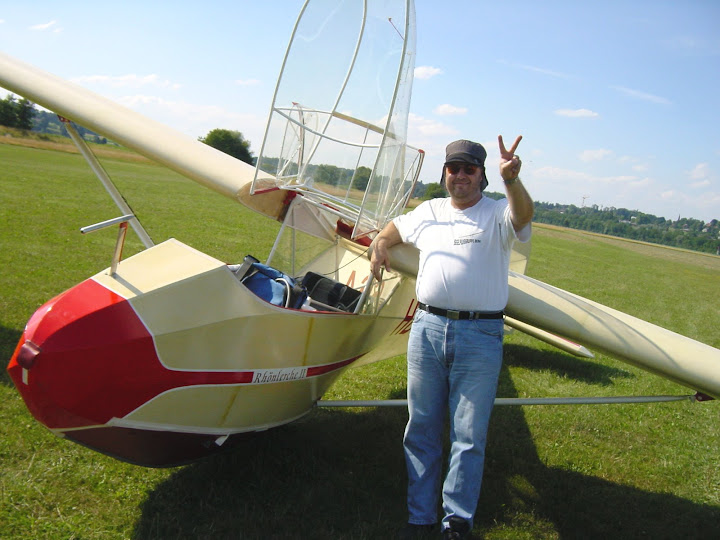
I set up a web site (using Google Apps, of course) so that the people who work on the glider (Mitchrampfer) could have some place to keep track of all of the work they do. They are meeting tonight to recover and refinish the elevator. The website is http://www.hb-664.ch/ . Here is a picture of Dänu after a flight in the Rhönlady.
Subscribe to:
Posts (Atom)